The data
The analysis covers direct (non-WIPO) applications filed with the:
USPTO (United States)
CIPO (Canada)
IP Australia
EUIPO (European Union)
UKIPO (United Kingdom)
IGE-IPI (Switzerland)
OEPM (Spain)
Madrid System designations were excluded so that each application reflects a single, locally filed decision about representation. The filing periods are 2025 for the EU, UK, Switzerland and Spain, 2024 for Australia and Canada, and March 2025 for the United States.
Key findings
Read the country breakdowns: United States · Canada · Australia · United Kingdom · European Union · Switzerland · Spain
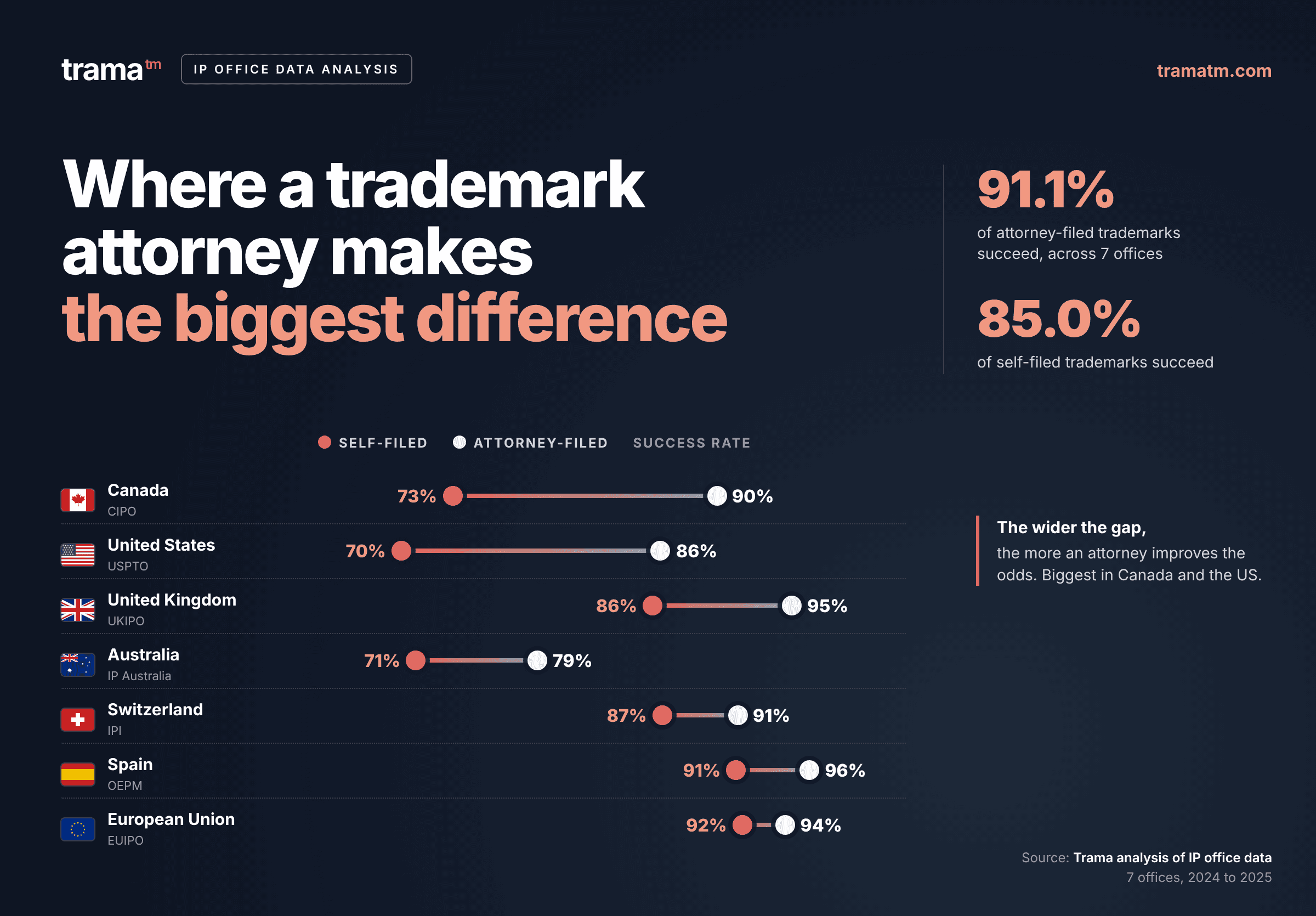
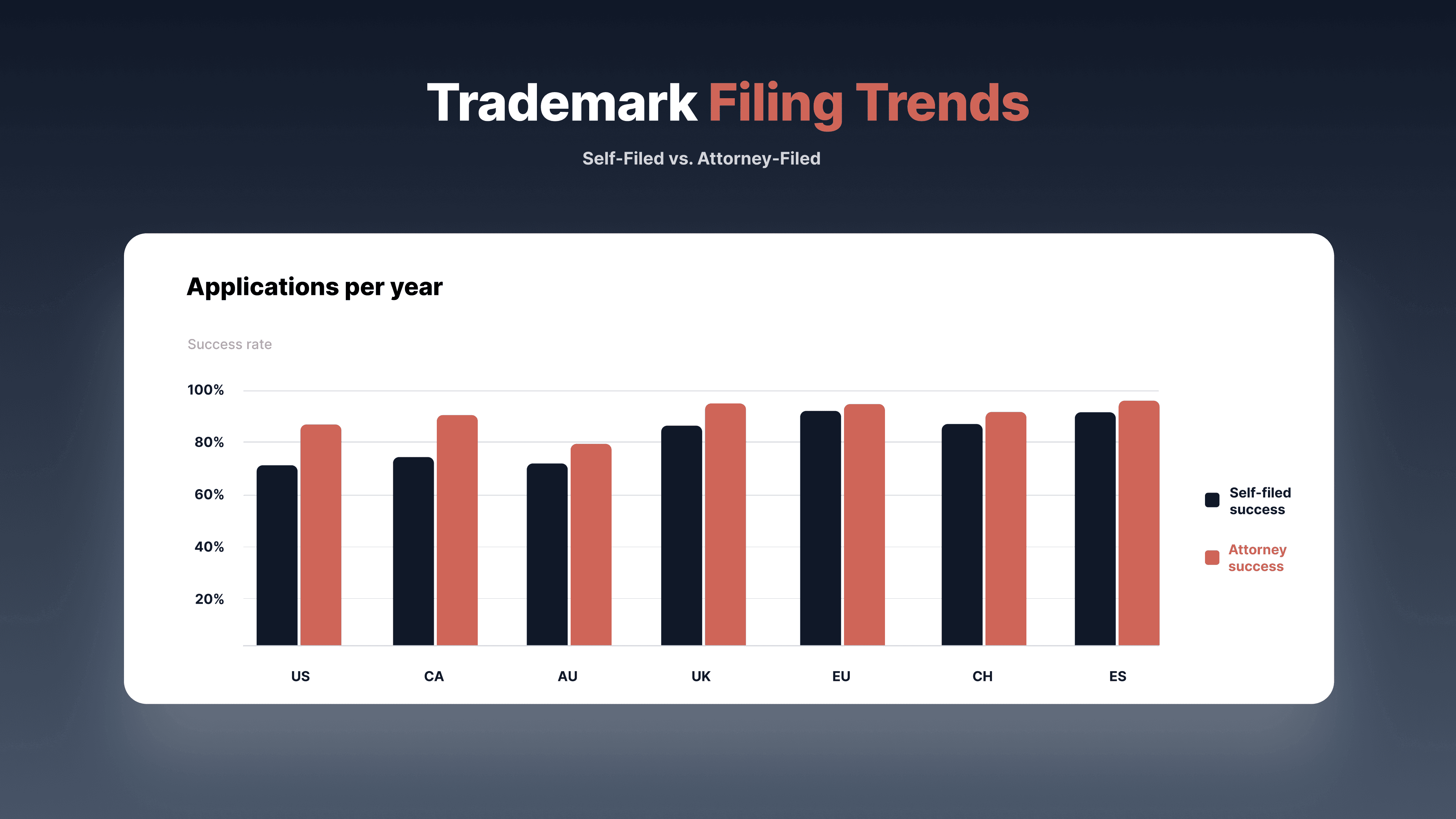
Pooled across all seven offices, self-filed applications succeeded 85.0% of the time, compared with 91.1% for attorney-filed applications. Put differently, 15.0% of self-filed applications failed against 8.9% of attorney-filed ones, making a self-filed application roughly 1.7 times as likely to fail. For every 1,000 applications, that is around 61 additional brands left without protection.
The advantage was consistent but not uniform. It ranged from 2.7 percentage points at the EUIPO to 16.5 points at CIPO, and the pattern behind that range can be explained by the specifics of the process in each country.
The gap is widest where offices examine for conflicts
The offices in our analysis differ in one important respect: whether examiners search the register for conflicting earlier marks. As set out in our analysis of trademark costs and examiner capacity, the USPTO, CIPO and IP Australia examine relative grounds as well as absolute grounds. The EUIPO and UKIPO, like the Swiss and Spanish offices, examine absolute grounds only and leave conflicts with earlier marks to the opposition process.
The representation gap follows this divide. In the three offices that examine relative grounds, attorney-filed applications succeeded on average 13.4 percentage points more often, with the largest gaps in Canada (16.5 points) and the United States (16.2 points). In the four offices that examine absolute grounds only, the average gap was 5.2 points, ranging from 2.7 at the EUIPO to 8.7 at the UKIPO.
This pattern is consistent with how examination works in practice. Where examiners proactively raise objections, including conflicts with earlier marks, more applications reach a stage at which the response decides the outcome, whether because a deadline is missed, the examiner is not persuaded by the arguments submitted, the specification has to be narrowed, or the applicant decides not to pursue the matter further. In those offices, the handling of objections has a greater influence on the final result, and so does professional representation.
What the data can and cannot tell us
The association is strong, though not the whole story. Self-filers and represented applicants are not identical groups: self-filers may skew toward smaller businesses and simpler marks, while attorneys may take on more contentious matters. Still, the advantage holds in all seven offices despite very different examination systems, filing cultures and self-filing rates, from 17% in the EU to 73% in Spain. That consistency makes the pattern difficult to dismiss.
Where local expertise meets global coverage
The data shows that the advantage of representation is local. It is strongest where offices raise the most objections, and it depends on knowing how each examiner works, what each office expects in a specification and how refusals are best overcome. Building and maintaining that expertise in every jurisdiction is rarely practical, whether for a business expanding into new markets or for a law firm advising clients across borders.
Trama offers both its clients and its partner firms access to that expertise through a single point of contact. Our local counsel cover 190 countries, supported by our own teams in the United Kingdom, United States and European Union. We file directly with national offices rather than relying on Madrid designations, so each application is prepared to the local office's requirements from the start.
With more than 35,000 trademarks registered and an overall success rate of 96.90%, partnering with Trama provides established global infrastructure for businesses and law firms alike.