Key figures
| Self-filed | Attorney-filed |
|---|---|---|
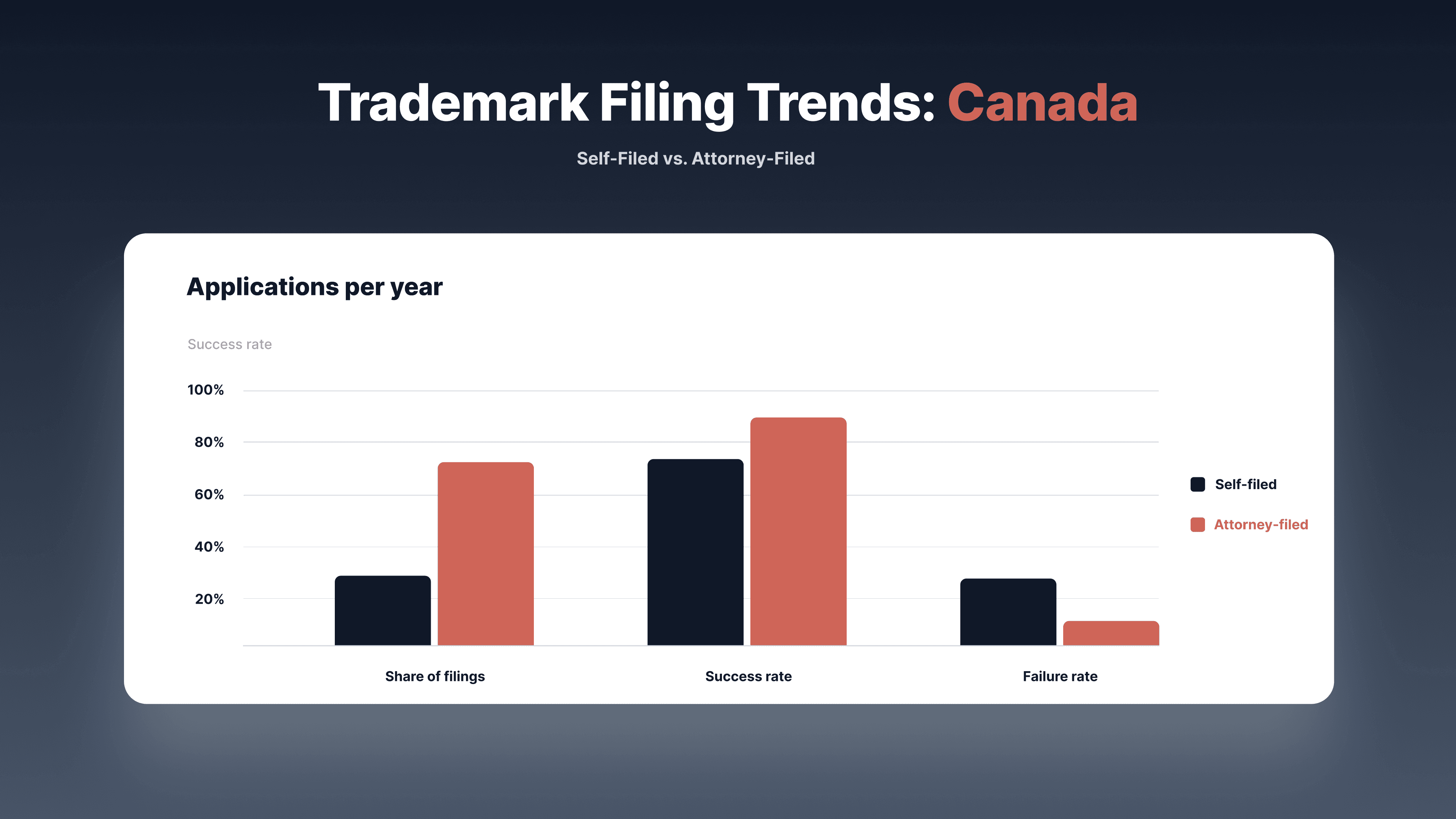
Applications (2024, direct filings) | 13,344 | 34,755 |
Share of filings | 27.73% | 72.27% |
Success rate | 73.4% | 89.9% |
Failure rate | 26.6% | 10.1% |
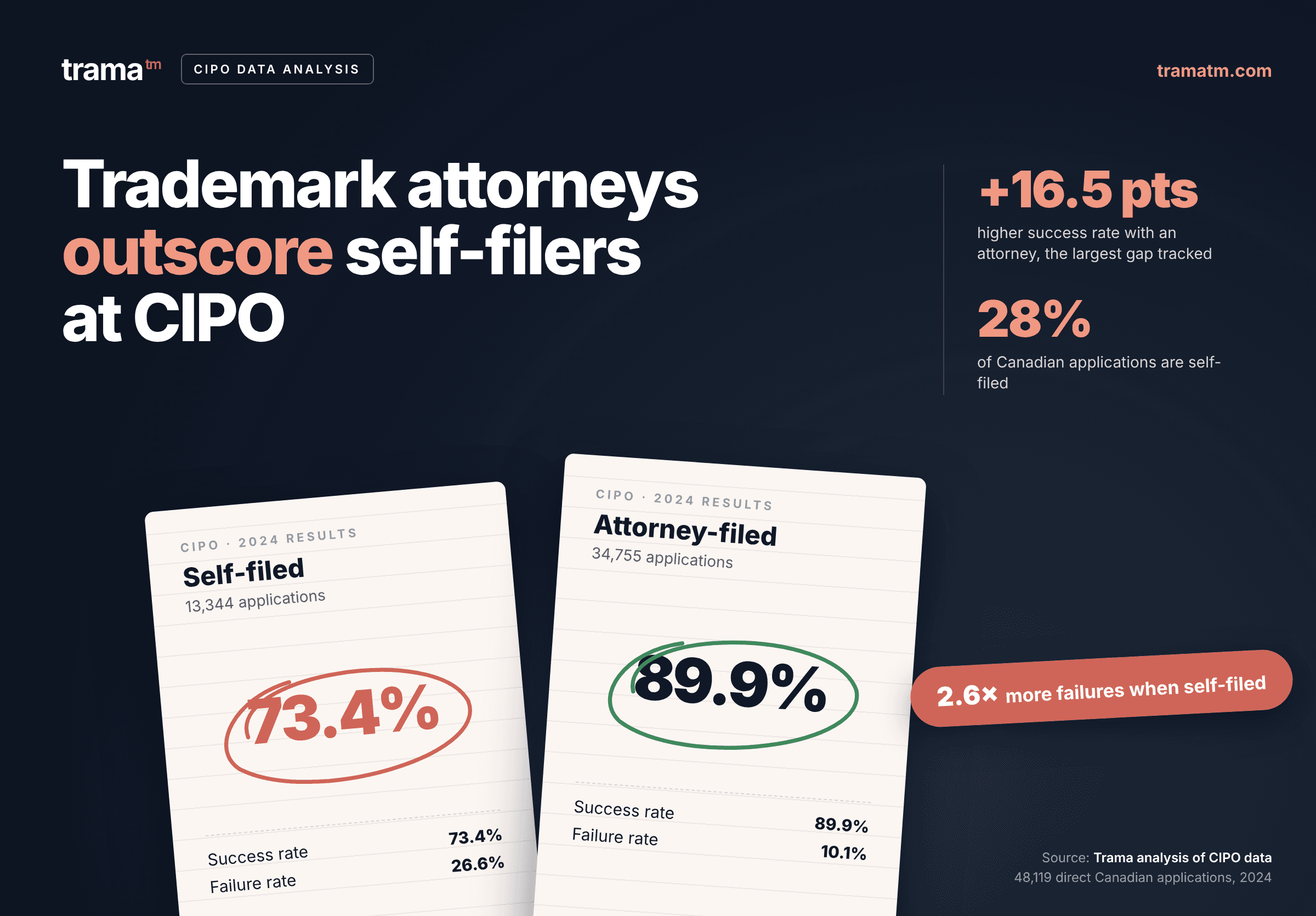
Across 48,119 direct applications filed in 2024, attorney-filed applications succeeded 16.5 percentage points more often. That corresponds to roughly 266 unsuccessful applications per 1,000 self-filed marks, compared with 101 per 1,000 attorney-filed marks.
General chance of registration success in Canada
Our earlier analysis of CIPO applications covered all applications filed between 2019 and 2023, including those filed through the Madrid System, and found an average success rate of 50.76%. The data in this article covers direct national filings only. Much of the difference can be attributed to Madrid filings: our analysis of office action risk per country found that 77.9% of WIPO applications designating Canada received at least one office action, the second-highest rate of any country analysed. Including these filings brings the average for all applications much lower than for direct filings.
Although the two datasets are not directly comparable, both give a consistent general picture of CIPO as an office that applies close scrutiny to the applications it examines.
Examination scope at CIPO
CIPO examines applications on both absolute and relative grounds. Examiners assess distinctiveness and the description of goods and services, and also search the register for earlier marks that could cause confusion, raising any conflicts in an examiner's report. As our analysis of trademark costs and examiner capacity shows, this places CIPO among the offices that conduct the broadest examination.
Because conflicts are raised by the office before publication, a larger share of applications require a substantive response, and the quality of that response has a direct bearing on the outcome. Canada has the largest representation gap in our analysis, at 16.5 percentage points. Across the seven offices, the gap averaged 13.4 points where examiners assess relative grounds, compared with 5.2 points where they do not, which suggests that the scope of examination is one of the main factors behind the difference.
Local considerations in Canada
CIPO examiner reports commonly address descriptiveness, confusion with earlier marks and the wording of goods and services, which must be grouped according to the Nice classes. Given the length of the process, objections may arrive well after filing, so deadline management across the full lifecycle of the application is an important practical consideration.
The local advantage for Canadian filings
With a detailed examination process and long processing times, Canadian filings benefit from counsel who work with CIPO regularly. Through our local counsel network, Trama files directly with CIPO, preparing each application to the office's standards from the start to minimise the risk of objections, and manages it through to registration. Businesses gain local expertise without having to find and manage Canadian counsel themselves, while partner firms can extend their clients' protection into Canada and continue to lead the strategy and the client relationship. Through our local counsel in 190 countries, the same brand can also be protected in other markets through a single point of contact.
With more than 35,000 trademarks registered and an overall success rate of 96.90%, partnering with Trama provides the infrastructure to support businesses and law firms in Canada and beyond.