Key figures
| Self-filed | Attorney-filed |
|---|---|---|
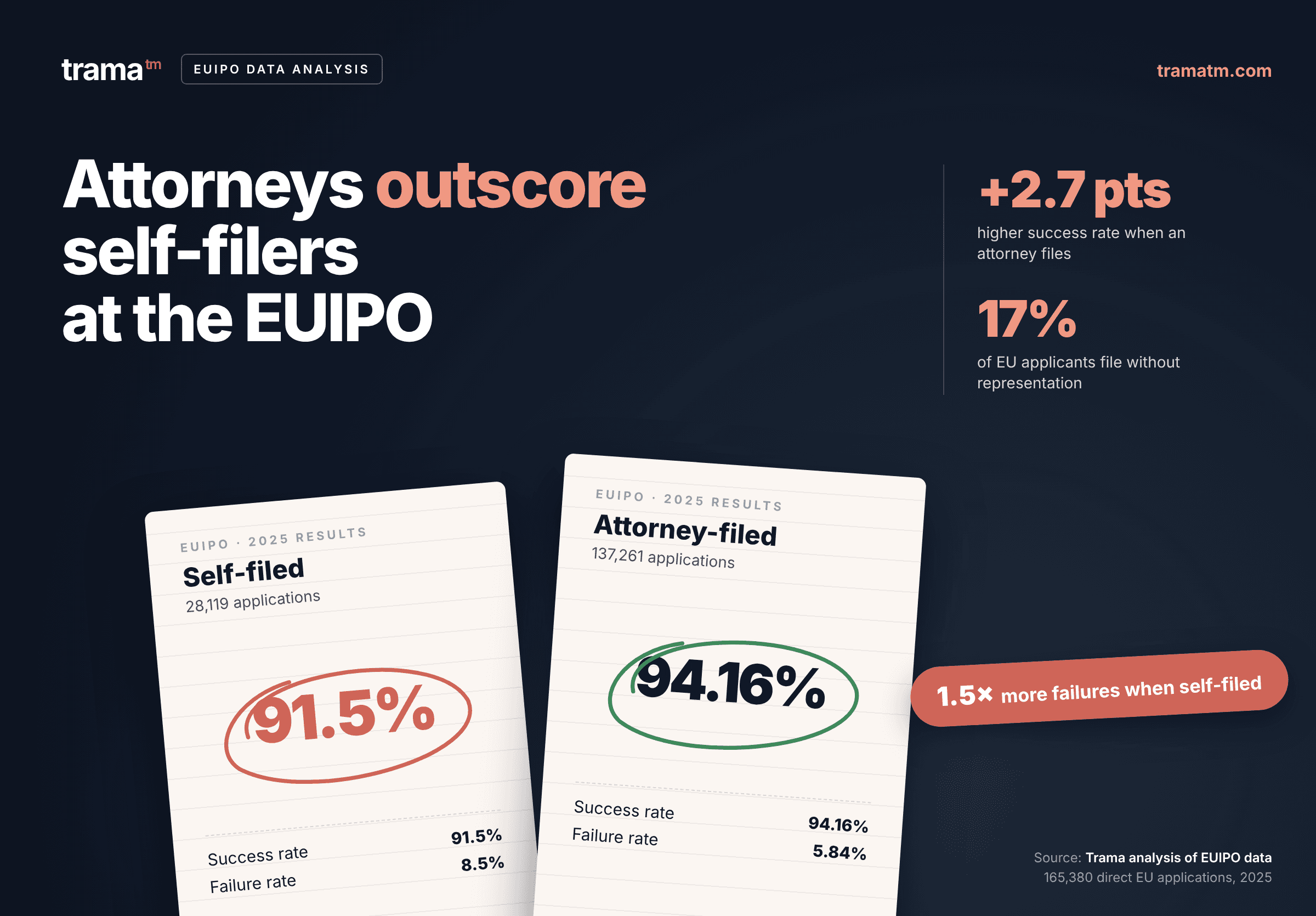
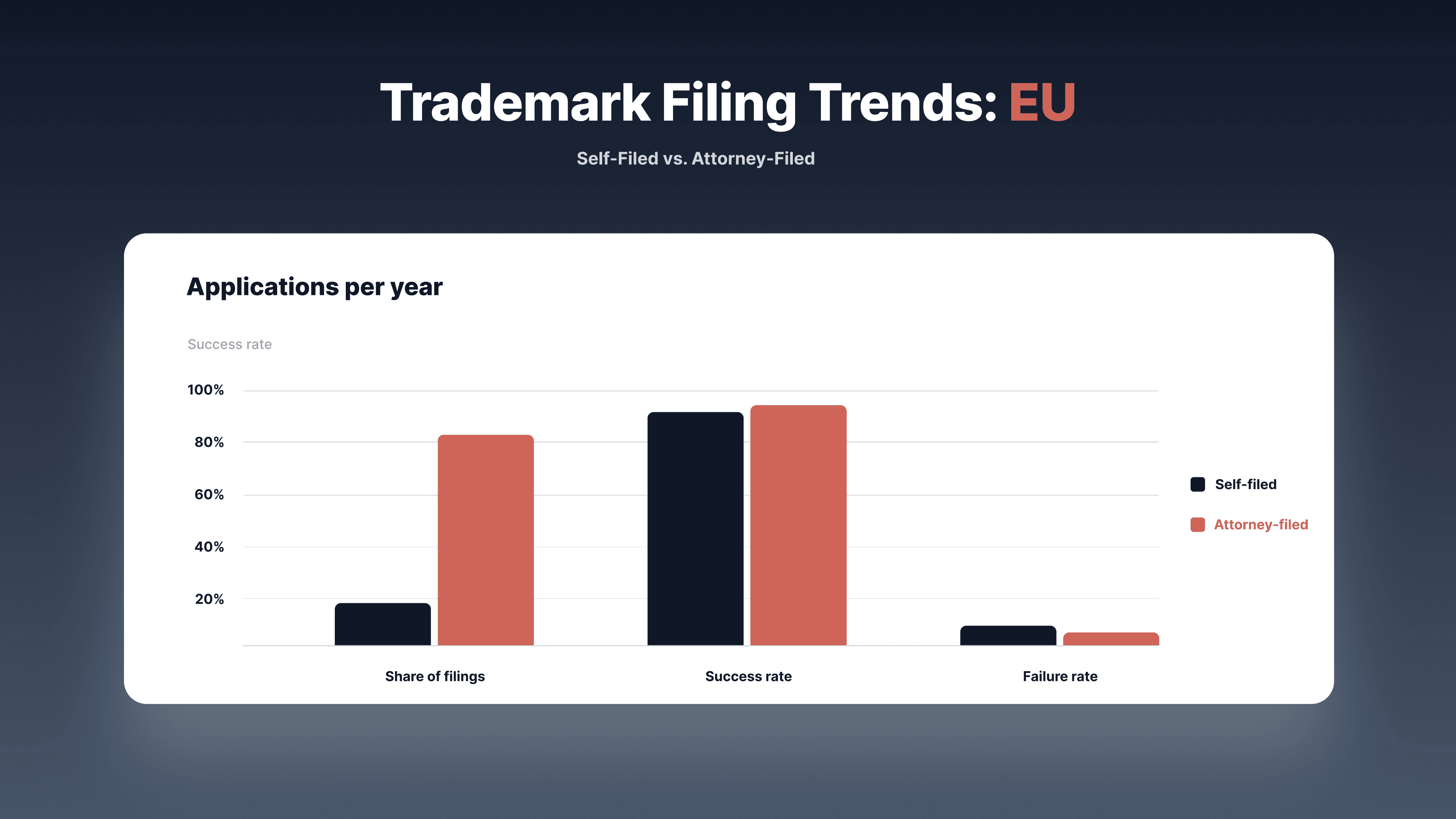
Applications (2025, direct filings) | 28,119 | 137,261 |
Share of filings | 17.00% | 83.00% |
Success rate | 91.5% | 94.16% |
Failure rate | 8.5% | 5.84% |
Across 165,380 direct EU trademark applications filed in 2025, attorney-filed applications succeeded 2.7 percentage points more often. This is the smallest gap in our dataset, although self-filed applications were still about 1.5 times as likely to be unsuccessful.
General chance of registration success in the European Union
Our earlier analysis of EUIPO applications covered all applications filed between 2019 and 2023 and found an average success rate of 90.80%, while the data in this article covers direct filings only.
Although the two datasets are not directly comparable, both give a consistent general picture of the EUIPO as one of the most applicant-friendly major offices, where even self-filed applications succeed at a rate matching the office's earlier five-year average.
Examination scope at the EUIPO
The EUIPO examines applications on absolute grounds only. Examiners assess whether a mark is distinctive and whether the goods and services are properly described, but, as our analysis of trademark costs and examiner capacity notes, conflicts with earlier marks are handled through opposition after publication.
This structure helps explain why the EU has both one of the highest success rates and the smallest representation gap in our analysis, at 2.7 percentage points. Fewer applications face substantive objections during examination, so there are fewer points at which the handling of a response decides the outcome. The main risk lies instead in opposition, which can be based on an earlier right in any of the 27 member states. For that reason, the value of representation in the EU is concentrated in clearance before filing and in defending oppositions if they arise.
Local considerations in the European Union
Because a single application covers all 27 member states, clearance needs to extend across multiple national registers and languages, not just the EU register. Applicants domiciled outside the EEA must be represented by a professional representative before the EUIPO.
The local advantage for EU filings
For applicants from outside the EEA, professional representation before the EUIPO is required, and because an opposition can be based on an earlier right in any member state, clearance before filing is essential. Trama's own EU team files directly with the EUIPO, acts as professional representative and prepares each application to the office's standards from the start, with clearance across national registers and specifications drafted to minimise the risk of objections and oppositions. Businesses gain local expertise without having to find and manage EU counsel themselves, while partner firms can extend their clients' protection across the EU and continue to lead the strategy and the client relationship. Through our local counsel in 190 countries, EU protection can also be combined with national filings in other markets through a single point of contact.
With more than 35,000 trademarks registered and an overall success rate of 96.90%, partnering with Trama provides the infrastructure to support businesses and law firms in the European Union and beyond.