A default that the data no longer supports
For much of Madrid's history, defaulting to it was the correct call: one application, one set of fees, coverage across every market a client needed. The filing data of the past decade, however, tells a different story than the one still shaping most firms' default advice.
In our recent analysis of Madrid filing trends, we tracked Madrid's share of total filings across major jurisdictions between 2014 and 2024. In the US, Germany, France and Spain, that share declined steadily even as overall filing volume increased. Fewer than one in twenty US trademark applications now proceeds through Madrid. The UK and EU appear to be exceptions, but the explanation is Brexit: coverage that once sat under a single filing split into two, producing a temporary spike in Madrid adoption that has already begun to reverse.
This decline reflects something the calculator makes concrete rather than theoretical: Madrid's fee structure is only advantageous at scale. Once the target list narrows to two or three countries, and local attorney costs are factored into both routes, direct filing frequently proves the more economical option.
A firm that recommends Madrid by default, without testing the actual figures, risks steering a client toward the costlier route while believing it has offered the simpler one.
The cost that arrives after the filing, not with it
Fees are only one half of the comparison. The other half is what happens once the application is filed, and it is here that Madrid's central promise becomes harder to sustain.
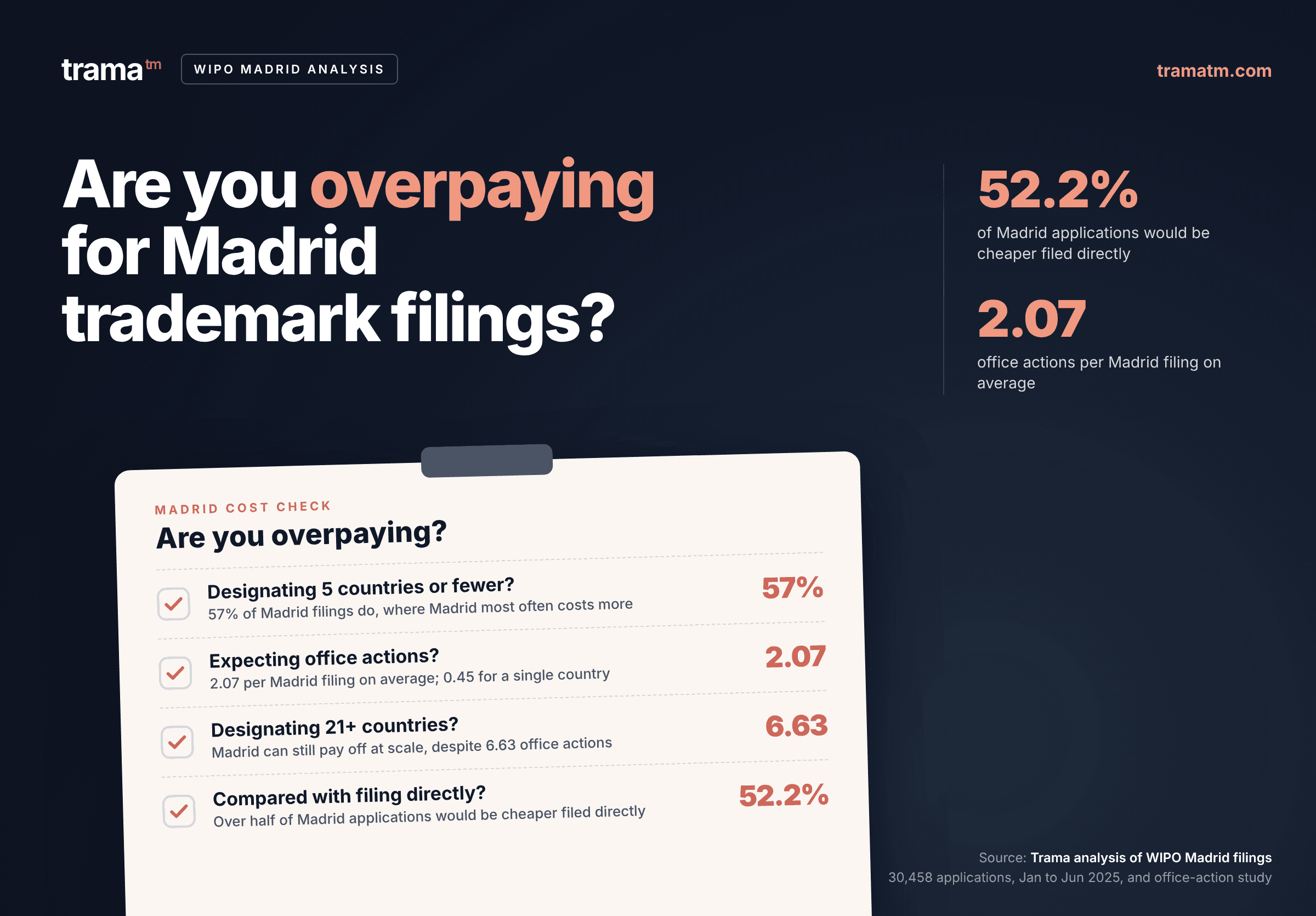
Madrid is marketed as a single application. In practice, it results in a single application forwarded to each designated country for fully independent local examination, and a substantial proportion of those examinations return objections. Our own study of office action risk by country found an average of 2.07 office actions per Madrid filing. Only around a quarter of applications cleared every designated country without objection. Nearly half received two or more, each carrying its own deadline, its own local response, and its own cost, typically not accounted for in the client's original engagement estimate.
That exposure scales with scope. A single-country designation averaged 0.45 office actions; a filing spanning 21 or more countries averaged 6.63. The United States illustrates the point most clearly: any applicant without US domicile requires representation by US-licensed counsel, a requirement Madrid filings do not satisfy on their own, making an office action there close to a certainty rather than a risk.
The filings Madrid was designed for are not the filings it typically receives
If Madrid's advantages materialize only at scale, the relevant question becomes how many filings actually operate at that scale. We examined this in a separate analysis of country combinations across WIPO applications, studying six months of filing data to establish what filers designate in practice, rather than what the system is positioned to deliver.
The pattern was not the broad, multi-jurisdiction filing Madrid is generally sold on. In reality, 57% of applications are designated five countries or fewer. Only around one in five designated eleven or more, the genuinely wide filings on which Madrid's economics depend. The most frequent patterns in the dataset were, in fact, single-country filings: US only, GB only, CA only, several of them among the same jurisdictions our office action research identified as carrying the greatest examination risk in isolation.
Applying the comparison across that dataset produces a clear result: 52.2% of all WIPO applications would be better served, and more cost-efficient, if filed directly. This is not a marginal segment of the market. It represents the majority of filers, currently being advised under a rule of thumb that does not, in fact, apply to them.
Testing the assumption before the invoice is sent
None of this renders Madrid obsolete. A client genuinely designating fifteen or twenty countries in a single filing continues to benefit from it, central attack risk notwithstanding, and the engagement remains straightforward to administer. But that client represents the exception in the data, not the norm. Most filers fall into the two, three, or five-country profile, precisely where Madrid's convenience is being paid for at a cost the client rarely sees itemized.
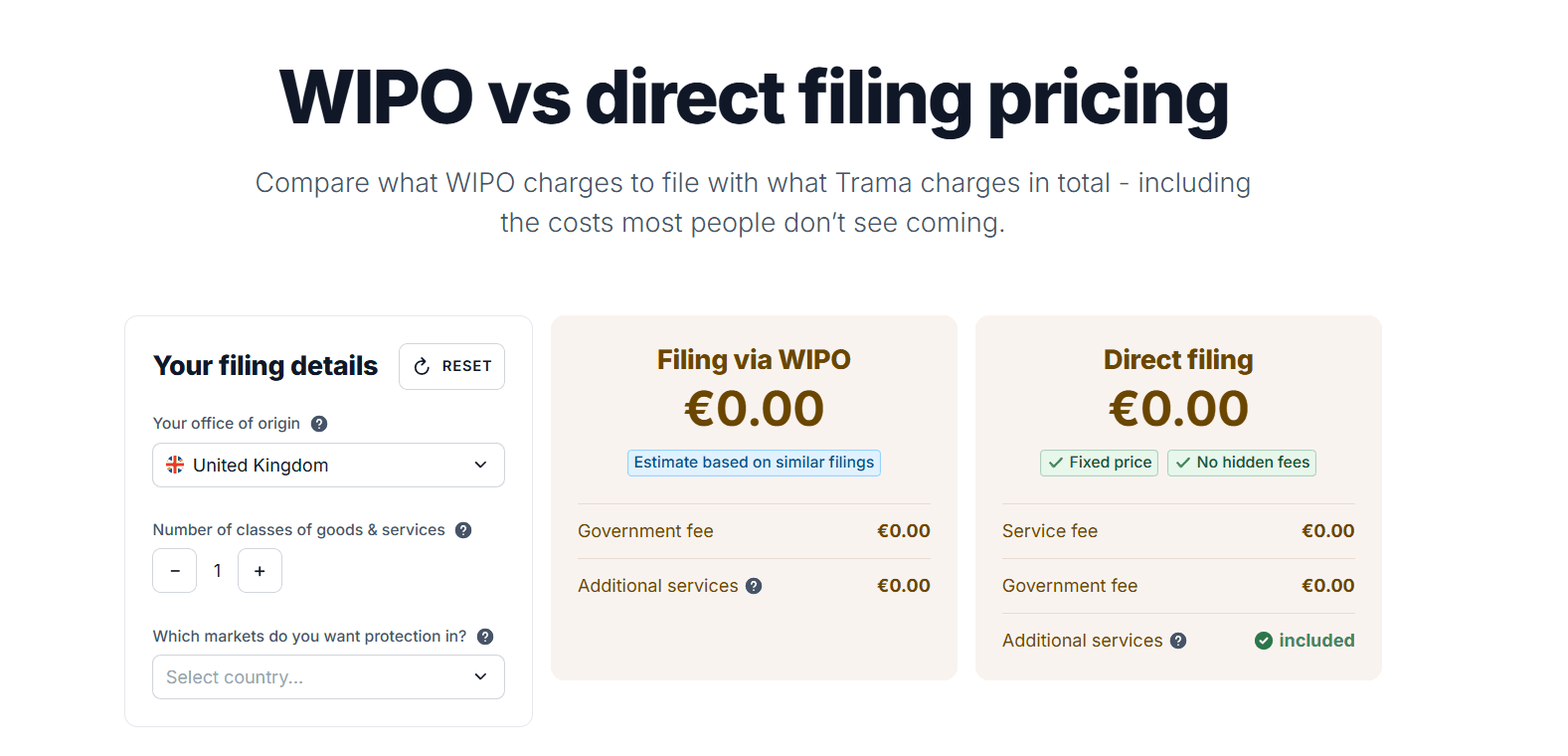
The practical step is a simple one. Before recommending Madrid on any matter short of a genuinely broad filing, run it through the WIPO calculator and review what the figures actually show. It takes only a few minutes, and it turns an assumption into something that can be put in writing.