The numbers behind Madrid's decline
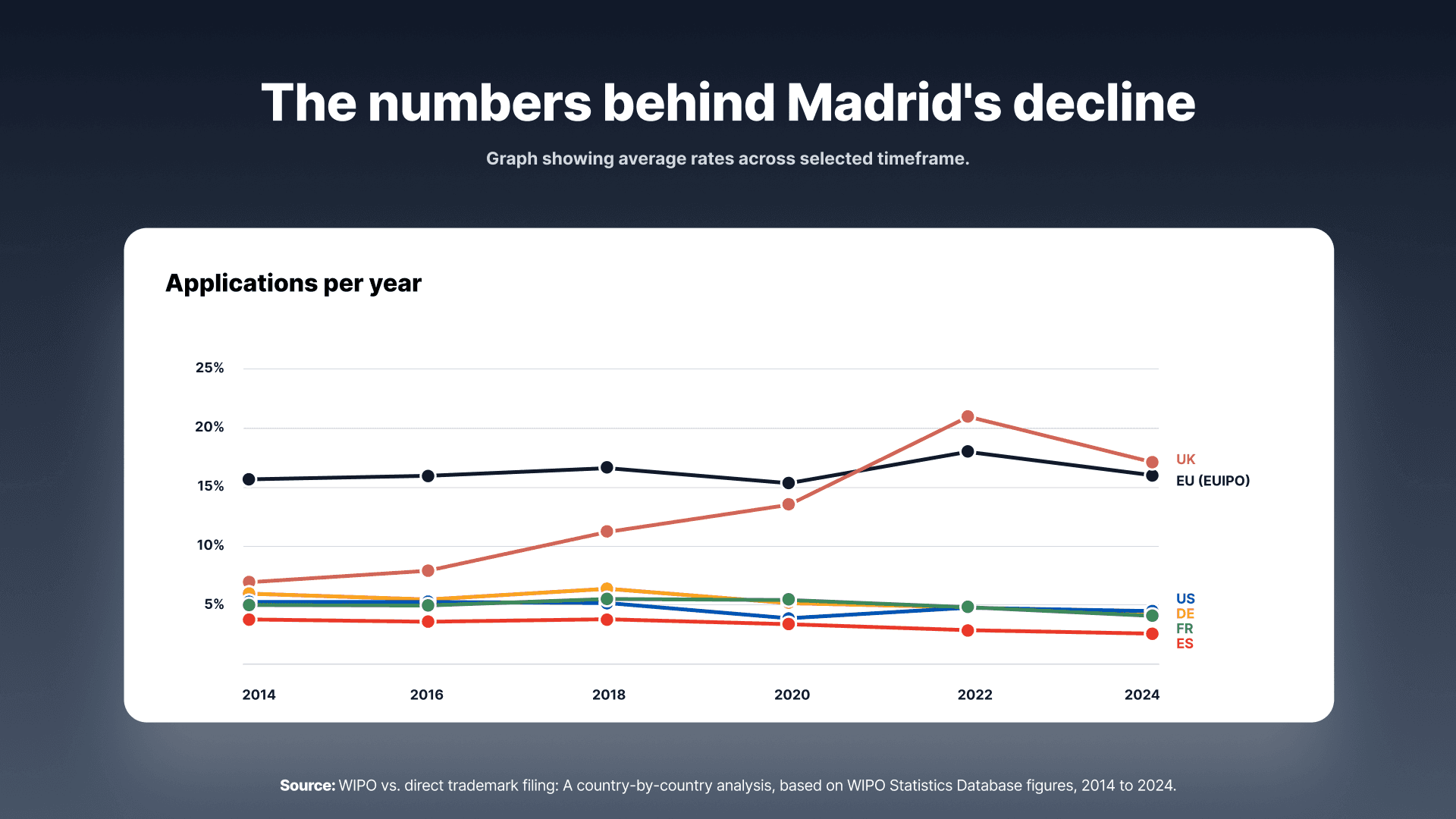
WIPO Statistics Database tracks how much of each country's total trademark filing volume arrives via the Madrid System, its "Madrid adoption rate." Looking at that rate from 2014 through 2024 for some of the world's most-filed-in jurisdictions a mixed pattern:
Source: WIPO vs. direct trademark filing: A country-by-country analysis, based on WIPO Statistics Database figures, 2014 to 2024.
In the US, Germany, France, and Spain, Madrid's share of total filings fell over the decade even as overall volume grew. Fewer than 1 in 20 US applications now goes through Madrid.
The UK and EU are two notable exceptions to this trend, and Brexit explains why. As UK-EU coverage split into two separate filings, Madrid adoption roughly tripled in the UK (6.9% to 20.8%) and rose in the EU (15.7% to 18.2%) through 2022. But by 2024 both had already pulled back, the UK to 16.7% and the EU to 15.9%, close to where the EU started a decade earlier.
Zoom out to the full set of 50 major offices WIPO tracks, and most show the same consistent decline over the decade, a sustained shift worth treating as a signal about where your own practice may be out of step.
Why clients (and their counsel) are moving away from Madrid
None of this is happening by accident. Practitioners who have run clients through the Madrid process point to a consistent set of structural issues that convenience alone doesn't offset, and each one has a direct operational consequence for the firm handling the filing.
Filing centrally doesn't mean the workload stays centralized
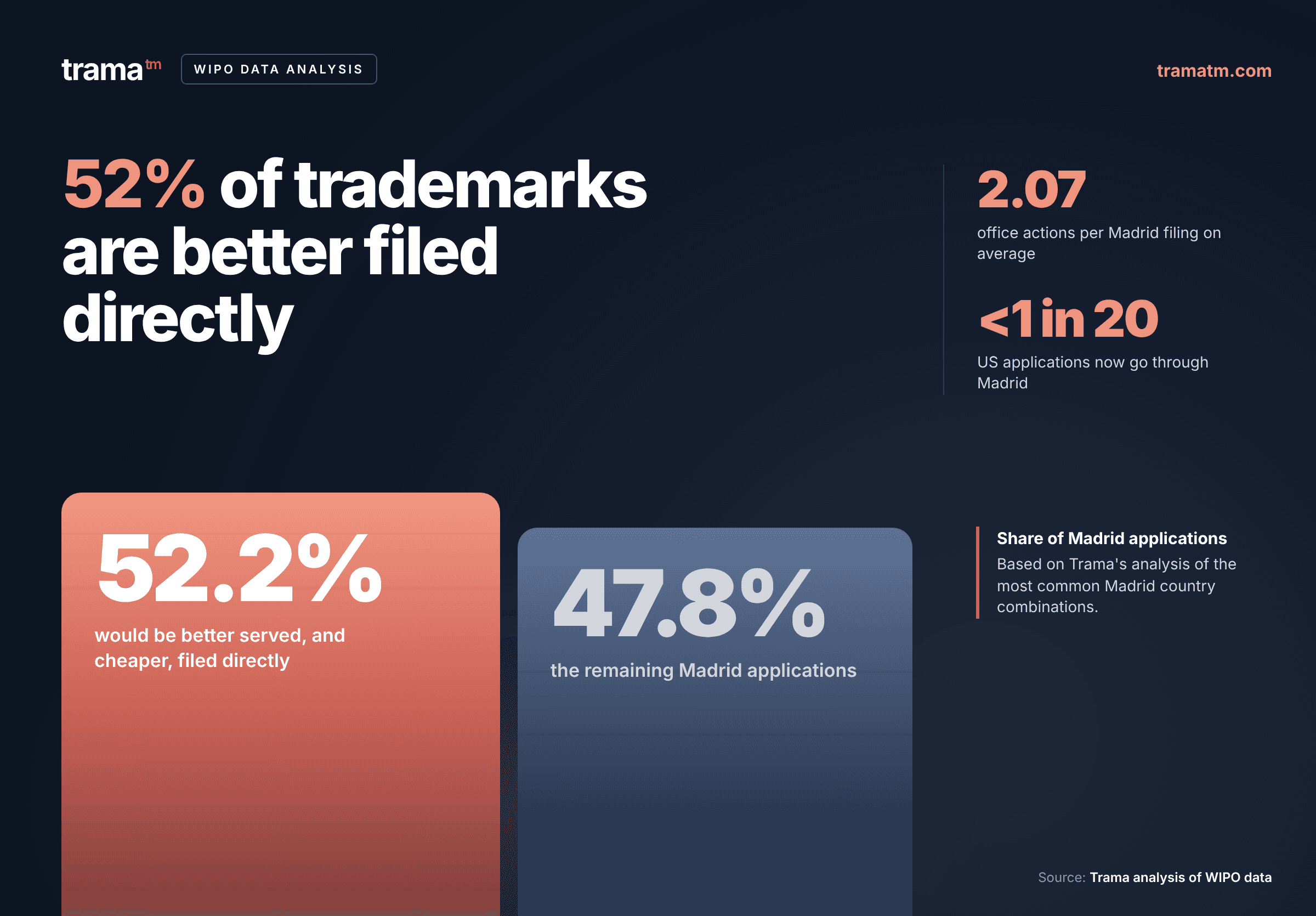
Madrid's promise is "one application." What it actually delivers is one application forwarded to each designated country's IP office for fully independent local examination, and a large share of those examinations come back with objections. Trama’s analysis of a full quarter of Madrid filings found an average of 2.07 office actions per application, with only about a quarter of applications (24.94%) clearing every designated country cleanly. Nearly half (46.25%) picked up two or more office actions, each requiring its own local response, its own deadline, and its own line item the client didn't necessarily budget for. The risk compounds with scope: a single-country designation averaged 0.45 office actions, one designating 21 or more countries averaged 6.63.
The United States is the clearest example. Because the USPTO requires any applicant without a US domicile to be represented by a US-licensed attorney (a requirement a Madrid filing doesn't meet) virtually every US-designated Madrid application receives an office action citing the missing local representative. If your firm files into the US through Madrid without already lining up US counsel, that office action isn't a surprise, it's a near-certainty you can and should be pricing into the engagement from day one.
For firms without an established foreign correspondent network, this is where a Madrid-first practice turns into a series of scrambled referrals after the fact. For firms with one, it's an opportunity to set expectations up front rather than explain an unexpected bill later.
The fee structure isn't automatically cheaper
Madrid's fees scale with the number of classes and countries designated, and its cost advantage really only shows up at scale, filing across fifteen or twenty countries at once. For a client targeting two or three specific markets, direct filing is frequently the cheaper route once local attorney costs are factored in.
Recommending Madrid by default for a narrow filing program, without running the actual numbers, risks steering a client toward the more expensive option while believing you've offered the simpler one. Trama's WIPO cost and risk calculator compares Madrid's total cost against direct filing fees for specific target countries, alongside the documented office action risk in each, a useful way to show a client the comparison in writing rather than asserting it.
A narrow home filing limits your client's protection everywhere else
A Madrid designation can't expand on the goods and services terms approved in the base registration. If the home filing lists narrow, dated, or overly literal language, every country designated through Madrid inherits that same limited scope, even in markets where broader terms would be accepted and would serve the client better. This is worth raising before the base application is filed, not after a designation comes back narrower than expected.
A single problem, every market's consequence
The most structurally critical risk of WIPO filing is known as "central attack." For the first five years of a Madrid registration's life, every country it covers remains legally dependent on the home-country base mark staying intact. If that base registration is cancelled, narrowed, or successfully opposed at home for any reason, the entire international registration falls with it, every designated country, all at once.
It isn't a hypothetical; it's a documented, recurring risk that IP counsel routinely flag to clients, and for businesses in contested sectors or facing aggressive competitors, it can be the deciding factor against using Madrid at all.
Where Madrid still earns its keep, and a decision rule worth adopting
None of this means Madrid is obsolete. For a client genuinely designating fifteen or twenty countries in one motion, the administrative simplicity and per-country cost still add up in its favor, central attack risk notwithstanding, and it still generates a straightforward, defensible engagement for the firm handling it. But most Madrid filings don't look like that. According to Trama’s analysis of the most frequent country combinations filed through Madrid, 52.2% of all WIPO applications would be better served, and more cost-efficient, when filed directly.
The typical filer is targeting a small, specific cluster of markets, exactly the profile where central attack risk, office action exposure, and the scope ceiling outweigh the convenience of one application, and exactly where a partner firm like Trama, with a strong network of trademark attorneys, can offer a better outcome and more durable engagement work than a single Madrid filing ever would.