
How many countries does a typical filing actually designate?
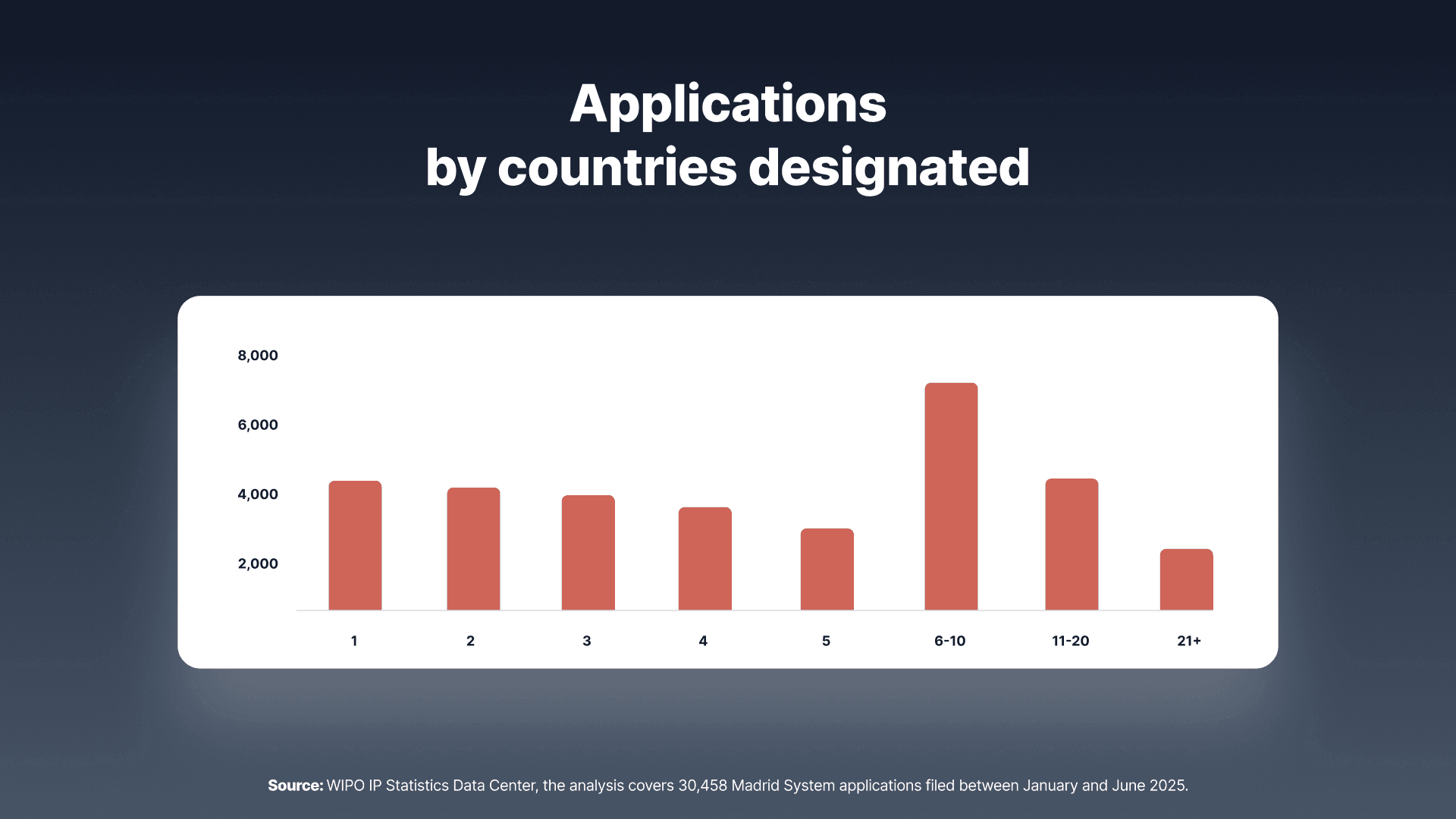
Source: WIPO IP Statistics Data Center, the analysis covers 30,458 Madrid System applications filed between January and June 2025.
The table shows two very different groups of filers. 57% of applications designate five or fewer countries, a small, targeted filing rather than a global rollout. Only about 20% designate 11 or more, the broad, many-country filings Madrid was actually built for.
That matters for how you staff and price this work. Madrid's cost and administrative advantages scale with the number of countries designated, as covered in our earlier analysis of WIPO's declining adoption rates. A client in the "five or fewer" group, which is the majority of the market, is not the client who benefits most from filing through Madrid, and every one of those files is a candidate for a direct-filing quote you may not currently be offering.
Which countries appear most often
Looking at how frequently each jurisdiction is designated, regardless of what else is included in the same application, a small group of major economies dominates:
Rank | Country | Applications Designating | Share of Total |
|---|---|---|---|
1 | European Union (EU) | 13,704 | 45.0% |
2 | United Kingdom (GB) | 13,609 | 44.7% |
3 | United States (US) | 11,759 | 38.6% |
4 | Canada (CA) | 9,816 | 32.2% |
5 | China (CN) | 8,507 | 27.9% |
6 | Australia (AU) | 7,637 | 25.1% |
7 | Japan (JP) | 7,346 | 24.1% |
8 | Switzerland (CH) | 6,679 | 21.9% |
9 | South Korea (KR) | 6,074 | 19.9% |
10 | India (IN) | 6,055 | 19.9% |
11 | Mexico (MX) | 5,870 | 19.3% |
12 | Brazil (BR) | 5,401 | 17.7% |
13 | Singapore (SG) | 5,307 | 17.4% |
14 | Thailand (TH) | 4,628 | 15.2% |
15 | Indonesia (ID) | 4,544 | 14.9% |
The EU and UK are each designated in close to half of all applications, and the US and Canada in nearly two out of five. These are also, notably, the jurisdictions our flagged as carrying meaningful examination risk on their own, with the US in particular effectively guaranteeing an office action for any Madrid filer without a US-domiciled representative.
If your firm doesn't already have a reliable, responsive correspondent in countries such as the US or Canada, that's the single highest-leverage gap to close given this distribution, since it's where the office-action work is going to land regardless of which client walks in the door.
The actual combinations businesses choose
Individual country frequency only tells part of the story. Looking at the specific combinations filed together shows just how concentrated real filing behavior is around a small set of recurring patterns:
Rank | Combination | Applications | Share of Total |
|---|---|---|---|
1 | US only | 752 | 2.47% |
2 | EU only | 745 | 2.45% |
3 | EU + GB | 579 | 1.90% |
4 | EU + US | 567 | 1.86% |
5 | CN only | 396 | 1.30% |
6 | CA only | 333 | 1.09% |
7 | EU + GB + US | 325 | 1.07% |
8 | GB only | 251 | 0.82% |
9 | CH only | 226 | 0.74% |
10 | GB + US | 225 | 0.74% |
11 | CH + EU + GB | 203 | 0.67% |
12 | CA + US | 185 | 0.61% |
13 | CH + GB | 184 | 0.60% |
14 | CA + EU + GB | 182 | 0.60% |
15 | CA + MX | 177 | 0.58% |
16 | CH + EU | 159 | 0.52% |
17 | CN + EU + US | 140 | 0.46% |
18 | CN + US | 124 | 0.41% |
19 | CH + GB +NO | 123 | 0.40% |
20 | AE only | 107 | 0.35% |
Single-country filings dominate the top of the list: US only, EU only, GB only, CH only, CA only, and CN only together account for a large share of the top 20 combinations. These are, by definition, filings where Madrid's multi-country pooling has no chance to pay off, since there's nothing to pool, and they're also the easiest matters to win away with a straightforward direct-filing quote, since there's no multi-jurisdiction coordination story to compete with.
Even the multi-country combinations near the top are small clusters of two or three closely related jurisdictions (EU and GB, EU and US, EU, GB and US), not the broad 15 or 20-country spreads that make Madrid's economics work in its favor. Trama's WIPO cost and risk calculator, which compares Madrid's total cost, including fees, class supplements, and the local representative costs Madrid doesn't remove, against direct filing for specific target countries, is built for exactly this comparison, and running it before recommending Madrid on a single-country or two-country matter costs nothing and can only strengthen the advice you give.
What this means for filing strategy
Taken together, the data points to a mismatch between how Madrid is marketed and how it is actually used. As set out in our earlier look at , the system's structural advantages, its cost efficiency and administrative simplicity, only really materialize at scale, when a single application is doing meaningful work across many jurisdictions at once.
But that is not the typical Madrid filing. More than half designate five or fewer countries, and the single most common patterns in the entire dataset are one-country filings. For that majority of filers, Madrid's central attack risk, its dependence on local representatives once an office action lands, and its cap on scope tied to the home registration are all being accepted for a convenience the filing itself barely uses.
This is exactly where firms have room to do better by their clients rather than just process the paperwork. Running the specific combination through a direct cost comparison, and choosing a reliable direct filing partner like Trama when the numbers favor it, is how a firm turns a routine filing decision into real, demonstrable value for the client.