
Most business owners think about brand risk in a very specific way: does anyone else have my name? They run a quick Google search, maybe check the USPTO database, and if nothing obvious comes up, they assume they're in the clear. Then they file, wait, and hope.
But there is a hidden layer that sits underneath that question, and it has nothing to do with whether your specific name is taken. It has to do with how many other businesses are filing in the same legal category as you, right now, every single year. And that number varies so dramatically across the US trademark system that two business owners filing on the same day, with equally strong marks, can have completely different experiences based purely on what they sell.
In 2024, over 500,000 trademark applications were filed in the United States. That is not a single pool of competition. It is 45 separate pools, divided by product and service categories called trademark classes, each with its own level of crowding, its own prosecution dynamics, and its own realistic odds for first-time filers.
Understanding where your business sits in that distribution is one of the most practical and underused tools available to any brand owner navigating the trademark system.
Why trademark classes matter more than most people realize
When you file a trademark, you are not registering a name in the abstract. You are registering a name within a specific class of goods or services. The trademark system divides commercial activity into 45 categories, from chemicals and clothing to software and legal services. Your protection only applies within the classes you file in, and the validity of your application is judged against every other mark already registered or pending in those same classes.
This is why volume matters. A class with 80,000 annual filings is not just busier than a class with 1,300 filings. That means more prior marks to conflict with. More applications ahead of yours in the queue. More potential opponents watching new filings. More likelihood that an examiner will find something to cite against your mark.
The practical result is that the class you file in shapes your trademark experience before you have written a single word of your application.
The full picture: 2024 US trademark filings by class
Here is the complete breakdown of all trademark applications filed in the United States in 2024, ranked by volume. Find your class and you will immediately understand the competitive landscape you are entering.
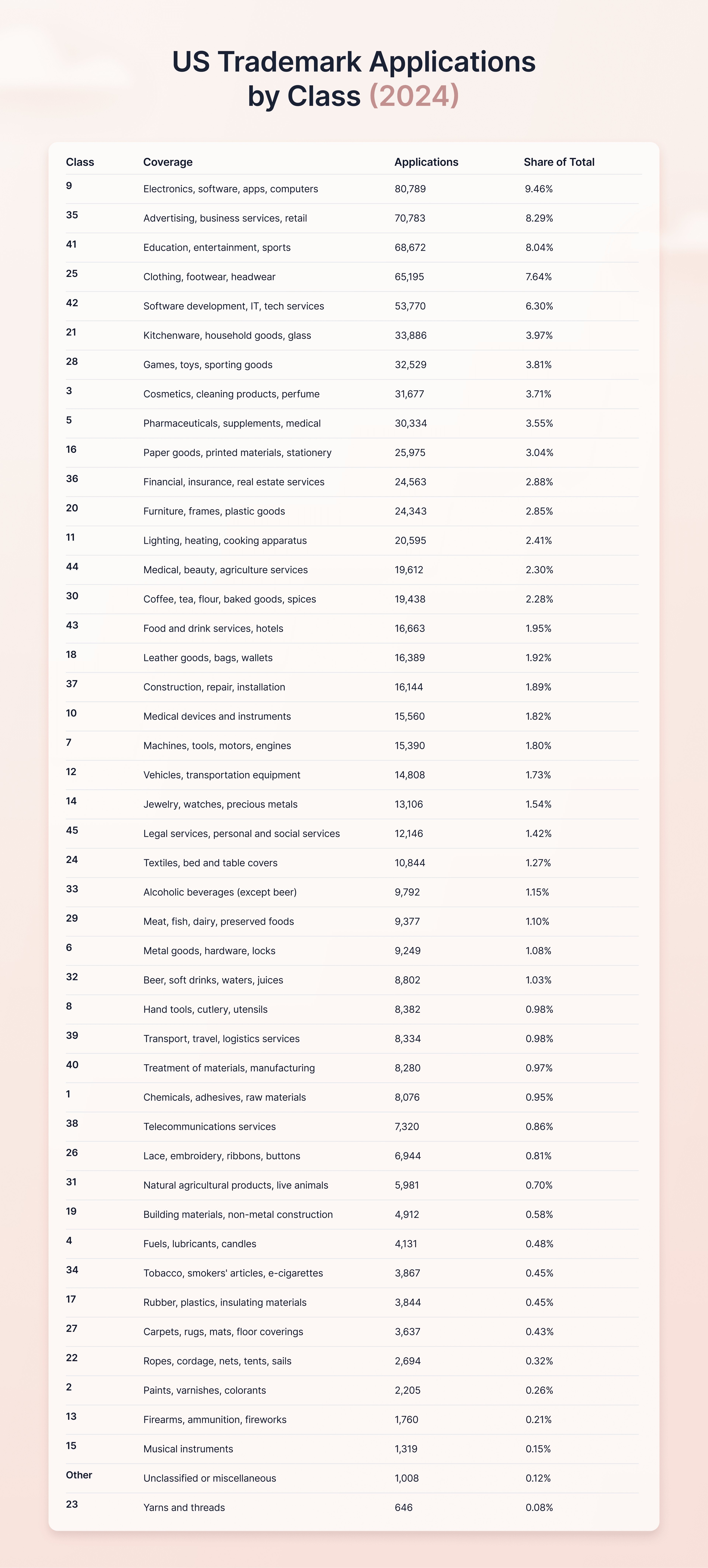
Source: WIPO Statistics Database, 2024. Includes direct IPO filings and designations via the Madrid system.
The main thing you should take away from these numbers is how top-heavy the distribution is. The five busiest classes (9, 35, 41, and 42) together account for more than half of all US trademark filings. If your business touches technology, retail, entertainment or digital services, you are operating in the most contested trademark territory in the country.
What this means for your application in practice
High filing volume in a class does not automatically mean your application will fail. But it does change the math in several concrete ways.
Opposition risk increases. Once your application publishes for opposition, any third party with a legitimate interest has 30 days to challenge it. In classes where large companies are filing aggressively, monitoring services are standard practice. The more crowded the class, the more eyes are watching new publications. Filing in Class 9 or Class 42 means your mark will be seen by the legal teams of some of the most trademark-active companies in the world.
The bar for distinctiveness rises. In a crowded class, common words and phrases in your industry are more likely to already be registered, applied for, or so widely used that they cannot be protected. The practical effect is that marks which might be registrable in a less-crowded class face a tighter squeeze in a dense one, pushing applicants toward more coined or distinctive marks to survive examination.
How to use this data before you file
None of this means you should avoid filing in competitive classes. If your business is a software company, Class 42 is not optional. The point is to go in with an accurate picture of what you are entering. Before filing, it is worth asking a few questions with class density in mind.
How distinctive is your mark relative to the crowding in your class? A moderately suggestive name might clear easily in Class 22. The same name in Class 35 could hit five existing registrations before your attorney finishes the search. The higher the volume in your class, the more you benefit from a mark that is genuinely distinctive rather than descriptive or industry-standard.
This is why a professional trademark clearance search, run before you file rather than after, is not a precaution. In a high-volume class, it is the foundation of any realistic filing strategy. Trama offers a free trademark check with results within 24 hours, which is a practical starting point before you commit to a name or spend anything on registration.