What a decade of client cases actually shows
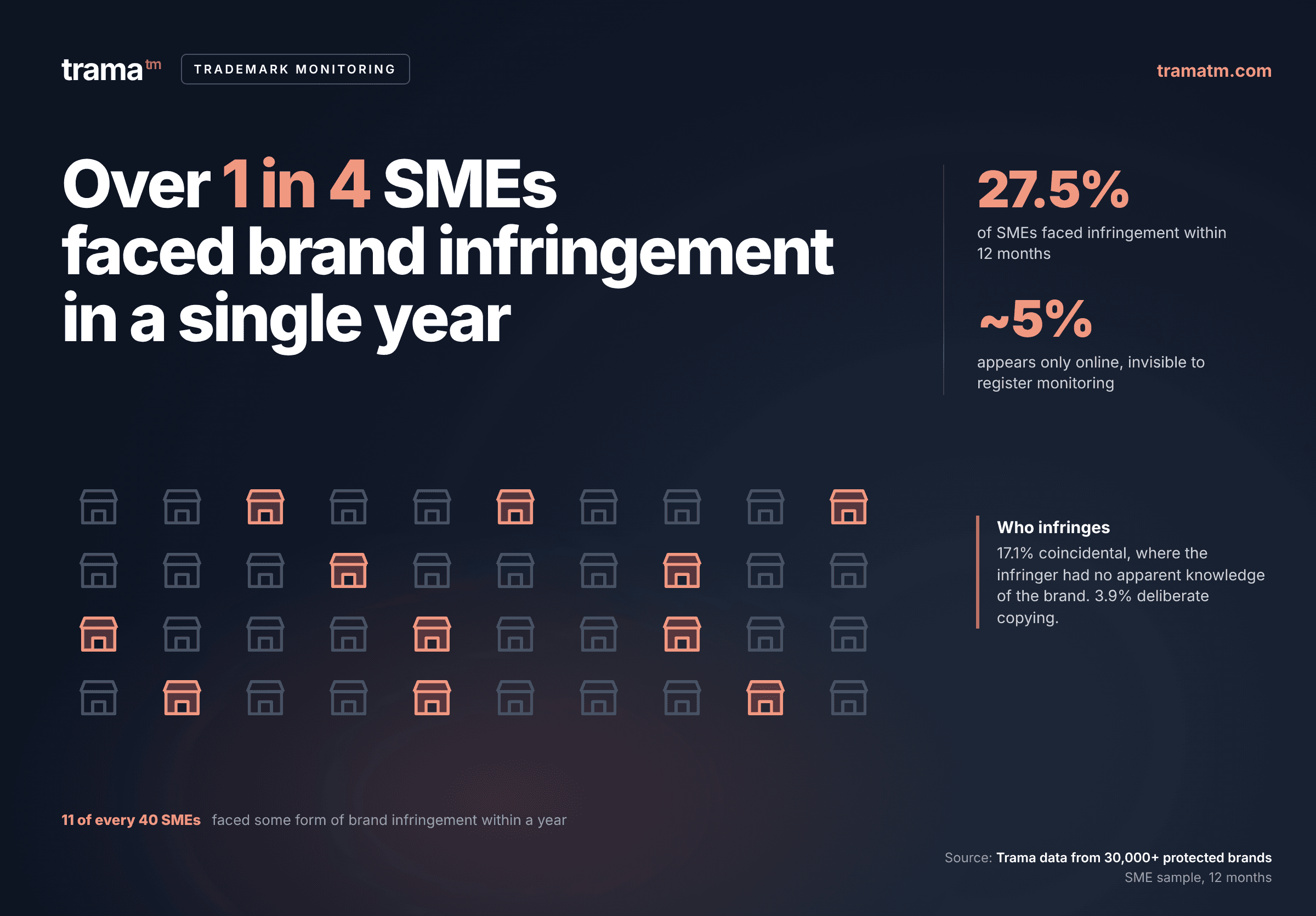
Drawing on our experience protecting over 30,000 brands, we looked at how often smaller companies actually encounter brand infringement, and where it shows up. The result: 27.5% of SMEs in our sample experienced some form of brand infringement over a 12-month period. One in four clients, every year.
Register-level threats, the kind standard monitoring is built to catch, account for a meaningful chunk of that: new companies formed with confusingly similar names (11.8%) and new trademark applications filed with overlapping goods, services, or territory (10.3%).
It's a threat category we've examined before, most recently through our own experience catching a near-identical mark filed in Italy's national register that EUIPO's own EU-level notifications never surfaced. That case is a good illustration of why register monitoring matters. It is not, however, the full picture.
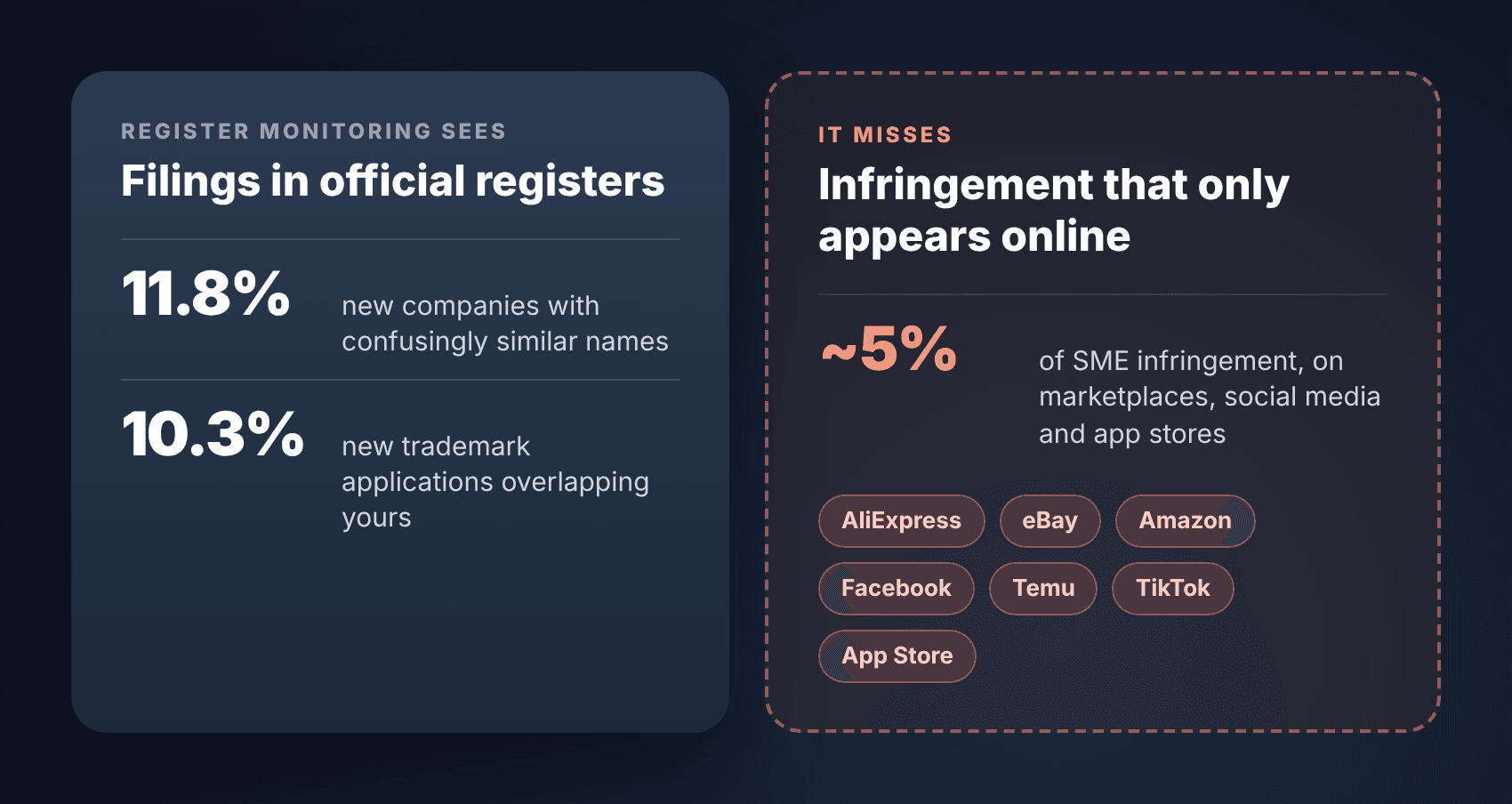
In addition to new trademark filings and new business entities being formed, ~5% of SMEs tend to experience trademark infringement on social media, online marketplaces, app stores and other online channels
Where the rest of it is actually happening
Once you move past registers, the infringement doesn't stop. It just moves somewhere your monitoring probably isn't looking:
AliExpress: 2.6%
eBay: 2.4%
Amazon: 2.2%
Facebook: 1.9%
Temu: 1.8%
YouTube: 1.8%
Instagram: 1.7%
TikTok: 1.4%
Shein: 1.3%
Google Play: 0.9%
App Store: 0.8%
Web domains: 0.7%
Etsy: 0.4%
Combined, these numbers represent a large share of the total 27.5%, and the infringement rarely stays confined to one platform. Facebook infringement overwhelmingly shows up on Instagram too. A similar pattern connects Google Play and the App Store, and AliExpress, eBay and Shein cluster together often enough to be a recognizable pattern rather than a coincidence. A client dealing with a knockoff listing on one marketplace is a reasonable bet to have the same problem on two or three more, and register monitoring alone will never tell you that.
Why the cause matters less than the timing
Of the SMEs that experienced infringement, only 3.9% involved a counterparty deliberately copying or imitating the brand. A much larger share, 17.1%, was coincidental: a business landing on a confusingly similar name or listing with no apparent knowledge of the original brand at all.
That distinction matters for strategy. Coincidental infringement, caught early, is often resolved with a simple notification or a friendly warning letter, before the other party has invested heavily enough in the brand to resist changing course. Deliberate infringement usually needs a firmer response, from platform takedowns for simpler cases to a more coordinated approach for organized attempts.
In both cases, the outcome hinges on the same variable: how early it's caught. A conflict discovered at the register level, three months after a similar listing has been live on Amazon, is a conflict caught too late on the channel that mattered more.
What this means for a firm already doing register monitoring well
None of this is an argument to stop watching trademark and business registers. It remains essential, and firms doing it properly are ahead of a large share of the market. The argument is that register monitoring and online-channel monitoring are answering two different questions, and offering only the first leaves a client's actual exposure only partly covered, often the larger part.
Register monitoring is something most firms can run themselves with the right process. Online-channel monitoring is a different operational problem, one we've already built the infrastructure to solve. Partnering with Trama instead of building it in-house means:
Continuous coverage across a dozen fast-moving marketplaces, social platforms, and app stores
Cross-platform detection, so a knockoff found on one marketplace flags where else it's likely to show up
Clear threat assessment, so your firm knows right away which cases need a firm response and which just need a simple notice
Pay-per-conversion pricing, so you only pay when a monitored threat actually turns into a client engagement
We're glad to walk through what a combined register-and-channel monitoring offering could look like for your client base. Schedule a free consultation today to find out more.