
Registering a trademark in the UK sounds like a straightforward process. You choose a name, instruct a solicitor or file directly with the trademark office, pay the fee, and wait. What most applicants do not realise until they are already in the system is that "waiting" means something very different depending on what your business actually sells.
In 2024, the UK Intellectual Property Office processed 172,943 trademark applications. But those applications did not spread evenly across the register. They piled into a handful of categories (called Nice classes) while other categories sat nearly empty. The result is a system where two businesses filing on the same day can face wildly different levels of competition, scrutiny, and delay, not because of anything wrong with their marks, but simply because of the product or service category they operate in.
172,943 Applications. 45 Buckets. Very uneven distribution.
The Nice Classification system divides all commercial activity into 45 classes: Classes 1 through 34 cover physical goods, Classes 35 through 45 cover services. Every trademark application must specify at least one class. Your protection is limited to the classes you file in, and your application is examined against every prior registration and pending application within those same classes.
This is the mechanic that makes volume data so important. When you file in a class with 37,000 other annual applicants, you are not competing with them directly. You are competing against the accumulated weight of every mark already registered there, plus every mark currently pending ahead of yours. The examiner reviewing your application is looking at the same crowded landscape, and so is any third party who might oppose your registration once it publishes.
Here is exactly how the 2024 UK filings broke down across all 45 classes:
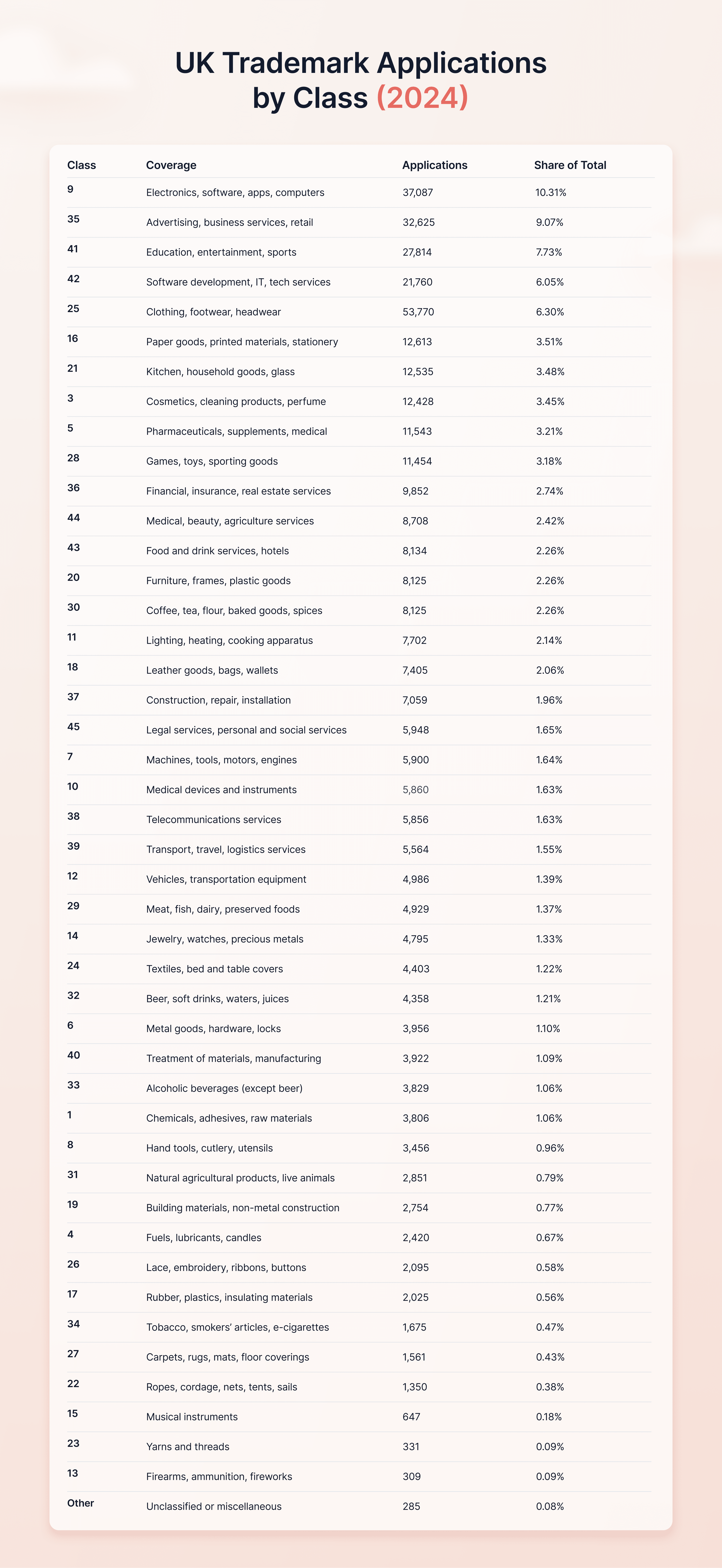
Source: WIPO Statistics Database, 2024. Includes direct IPO filings and designations via the Madrid system.
The four dominating classes
Class 9 alone accounted for 37,087 applications in 2024, more than one in five of every trademark filed in the UK that year. Add Classes 35, 41, and 42, and you have accounted for more than 30% of all UK filings across just four of the system's 45 categories.
That concentration has a simple explanation: modern businesses tend to have a digital dimension, and digital goods and services funnel almost inevitably into these four classes. Software, apps, and downloadable content live in Class 9. Online retail, subscription services, and business consultancy land in Class 35. E-learning platforms, streaming services, and online events fall under Class 41. Cloud services, APIs, and technology platforms belong in Class 42. The same startup could plausibly need to file in all four.
The result is that these classes have become extraordinarily competitive terrain. Prior registrations have accumulated over decades. Large technology companies and media businesses file continuously, supported by legal teams whose entire job is watching the register for conflicts. The marks that are easy to register (descriptive, generic, industry-standard) were claimed long ago. What remains available tends to be either highly distinctive or narrowly defined.
Three questions worth asking before you file
Is your mark strong enough for the class you're entering?
Trademark strength exists on a spectrum, running from generic (unregistrable) through descriptive and suggestive to arbitrary or invented (most protectable). Where your mark sits on that spectrum matters in any class. In a high-volume class, it matters more. The more filings there are, the more the descriptive and suggestive territory fills up, and the harder it becomes to clear a mark that is not genuinely distinctive. A name that would sail through Class 22 might face multiple citation refusals in Class 35. If you are filing into one of the top ten classes by volume, it is worth being honest about whether your mark is as distinctive as it needs to be, before you pay the fees, not after.
Have you mapped your business to the right classes?
The temptation is to file in the most obvious class and leave it there. But most businesses generate value across more than one category. A food brand selling products in Class 30 might also have branded packaging that falls under Class 16, a direct-to-consumer website that touches Class 35, and cooking events or content in Class 41. Gaps in class coverage are not just theoretical. They are the spaces through which a competitor can establish a conflicting registration and constrain your ability to expand. Working through all of your revenue streams and customer touchpoints before filing is dull work, but it is far less expensive than retrofitting your trademark strategy later.
Are you accounting for the post-Brexit landscape?
Since the UK left the EU trademark system, a UK registration and an EU registration are entirely separate instruments. Businesses that previously relied on a single EUIPO registration for UK coverage now need a dedicated UK filing to maintain protection here, and vice versa. This shift has contributed to the growth in IPO filings over recent years, as brands that previously ignored the UK register now have a reason to engage with it. It also means that UK examinations are no longer influenced by EUIPO precedent in the way they once might have been. The IPO is developing its own distinct body of practice, and what passes examination in Brussels does not automatically pass in Newport.
What the data cannot tell you
The filing volumes above describe the competitive environment you are entering. They do not predict your outcome. A well-constructed application for a genuinely distinctive mark can succeed in Class 9 just as a poorly chosen generic name will struggle in Class 23. The numbers are inputs to your decision-making, not verdicts.
What they do tell you is that the class you file in is a strategic choice, not a bureaucratic formality. Treating it that way is the single most underused advantage available to any brand owner at the start of the registration process.
Have you run a clearance search across the full register? In a class with tens of thousands of prior registrations, a quick google search is no longer enough. Trama offers a free trademark check with results delivered within 24 hours, covering the classes and markets relevant to your business. Running that check before you file costs nothing and gives you a clearer picture of what you are walking into.