
Where UK filing activity actually lands
Using the WIPO Statistical Database's origin-to-destination filing matrix for 2014 to 2024, this analysis looks at:
How UK-origin applicants split their filing between home and abroad
How Brexit shows up directly in that split
Where their outbound filings actually go
Who files into the UK from abroad
It's part of a wider look at this same question across a dozen major filing nationalities, covered in full here, if you want the broader comparison alongside the UK-specific detail below.
In 2024, UK-origin applicants filed 139,662 trademark applications worldwide, and 49,090 of them were filed abroad, a substantial standing volume of outbound work in its own right. The remaining 90,572 (64.9%) were filed only with the UK IPO; the outbound share came in at 35.1%.
Put another way: for roughly every two applications a UK applicant files at home, about one is filed abroad, a ratio of 0.54 international filings for every domestic one.
A decade shaped by one regulatory event
The UK's numbers move in a clear, three-act pattern tied directly to its departure from the EU trademark system.
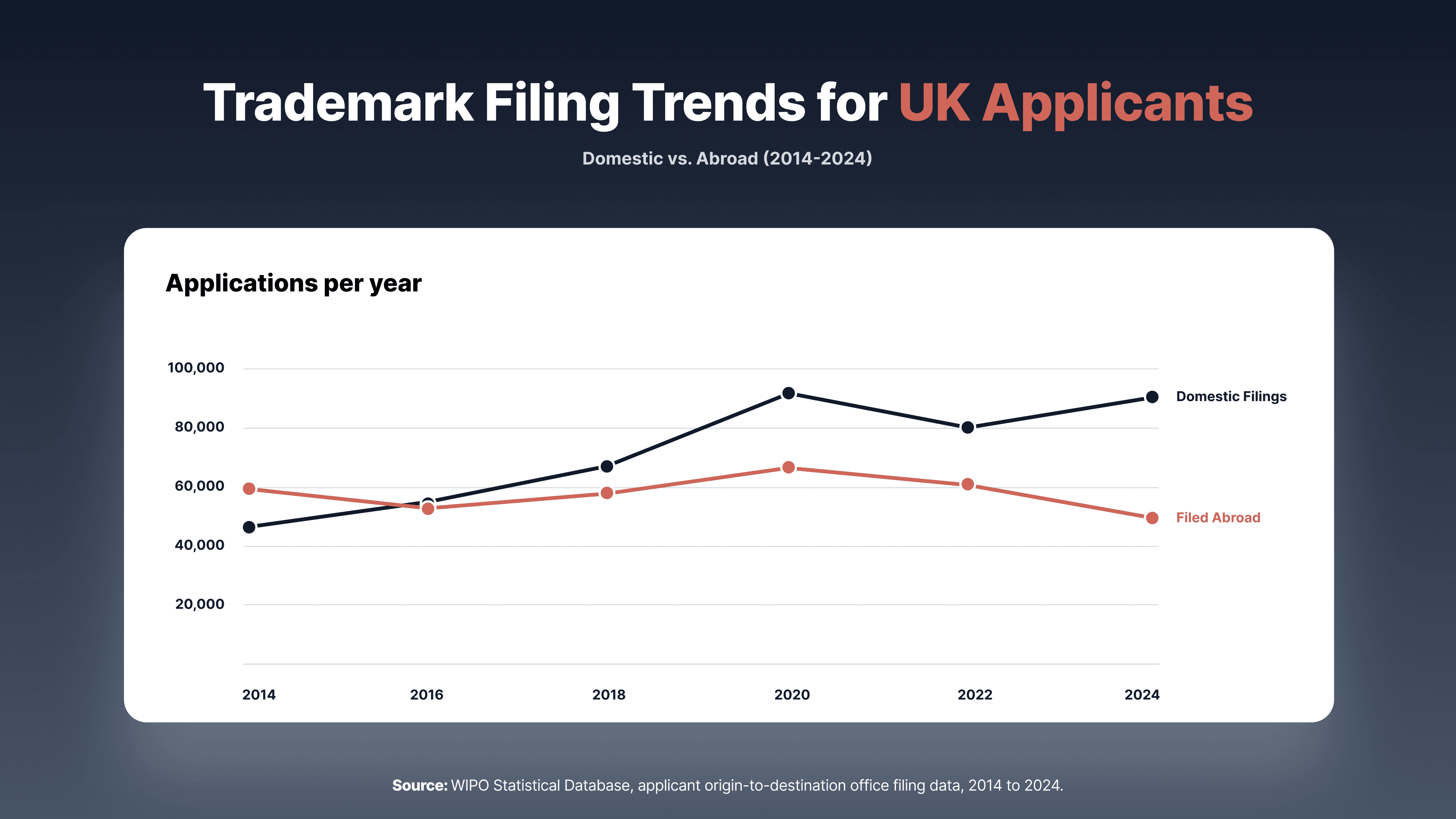
Source: WIPO Statistical Database, applicant origin-to-destination office filing data, 2014 to 2024.
Before Brexit, UK applicants filed more abroad than at home: in 2014, for every domestic filing there were 1.29 filed abroad, largely because a single EU designation delivered coverage across the EU and the UK together. As the UK's departure from the EU trademark system took effect, outbound volume climbed toward a peak of 66,481 in 2020, businesses moving to re-secure EU coverage that would no longer come bundled with a UK filing, while domestic filing grew even faster as UK protection became separate. Since that peak, outbound volume has fallen for three straight years, down to 49,090 by 2024, its lowest point in the dataset, even as domestic filing has kept climbing.
Where UK applicants actually file abroad
Looking at 2024, UK outbound filings concentrate heavily in two destinations before dropping off sharply:
Rank | Destination | UK-Origin Applications (2024) |
|---|---|---|
1 | United States | 8,533 |
2 | European Union (EUIPO) | 8,262 |
3 | Australia | 2,264 |
4 | Canada | 1,923 |
5 | India | 1,469 |
6 | Japan | 1,242 |
7 | South Africa | 1,137 |
8 | United Arab Emirates | 1,116 |
9 | China | 1,085 |
10 | Mexico | 1,020 |
The US and the EU together account for well over a third of all UK outbound filings. Beyond that pair, volume drops off quickly into a long list of Commonwealth-linked and major economies, Australia, Canada, India, South Africa, none individually large but collectively still a meaningful share of total outbound activity.
Who files into the UK from abroad
The UK market draws substantial foreign filing activity. Of the 172,849 total applications filed with the UK IPO in 2024, 82,277 (47.6%) came from applicants based outside the UK, nearly half of all UK filing activity. The largest foreign filer nationalities were:
Rank | Origin | Applications Filed in the UK (2024) |
|---|---|---|
1 | China | 31,761 |
2 | United States | 15,527 |
3 | Germany | 4,167 |
4 | France | 3,054 |
5 | Switzerland | 2,298 |
6 | Italy | 1,933 |
7 | Japan | 1,709 |
8 | Australia | 1,645 |
9 | Hong Kong | 1,503 |
10 | Netherlands | 1,340 |
China is, by a wide margin, the largest source of foreign filing into the UK, more than double the next largest source, the United States, and well ahead of the EU's major economies (Germany, France, Switzerland, Italy) that make up most of the remaining top ten.
How that outbound volume is actually being filed
Brexit didn't just change how much UK applicants file abroad, it changed how incoming filings reach the UK, too. Our earlier analysis of Madrid System adoption rates found that the share of total UK filing activity arriving via Madrid roughly tripled from 6.9% in 2014 to a peak of 20.8% in 2022, as businesses used Madrid to designate the UK and EU together in one motion, before easing back to 16.7% by 2024. Even at that peak, though, more than three-quarters of UK filing activity bypassed Madrid entirely. For a firm handling UK-facing work in either direction, direct filing has remained the dominant route throughout the entire post-Brexit period.
What this means in practice
The UK is a market in a transition: domestic filing at a record high, outbound volume down from its post-Brexit peak but still substantial, and foreign filing into the UK now approaching half of total UK filing activity. For firms handling either direction of this traffic, direct filing remains the default even after Madrid's Brexit-driven surge. can help size up the Madrid versus direct filing decision for any specific UK-bound or UK-outbound combination.