
Where South Korean filing activity actually lands
Using the WIPO Statistical Database's origin-to-destination filing matrix for 2014 to 2024, this analysis looks at:
How South Korean-origin applicants split their filing between home and abroad
How that balance has shifted over the decade
Where their outbound filings actually go
Who files into South Korea from abroad
It's part of a wider look at this same question across a dozen major filing nationalities, covered in full here, if you'd like the broader comparison alongside the South Korean-specific detail below.
In 2024, South Korean-origin applicants filed 268,388 trademark applications worldwide. Of those, 227,264 (84.7%) were filed only with the Korean Intellectual Property Office (KIPO), and 41,124 (15.3%) were filed abroad.
Put another way: for roughly every five applications a South Korean applicant files at home, less than one is also filed abroad, a ratio of 0.18 international filings for every domestic one, one of the more heavily domestic-weighted balances of any major filing nationality.
Has outbound volume grown, shrunk, or held steady?
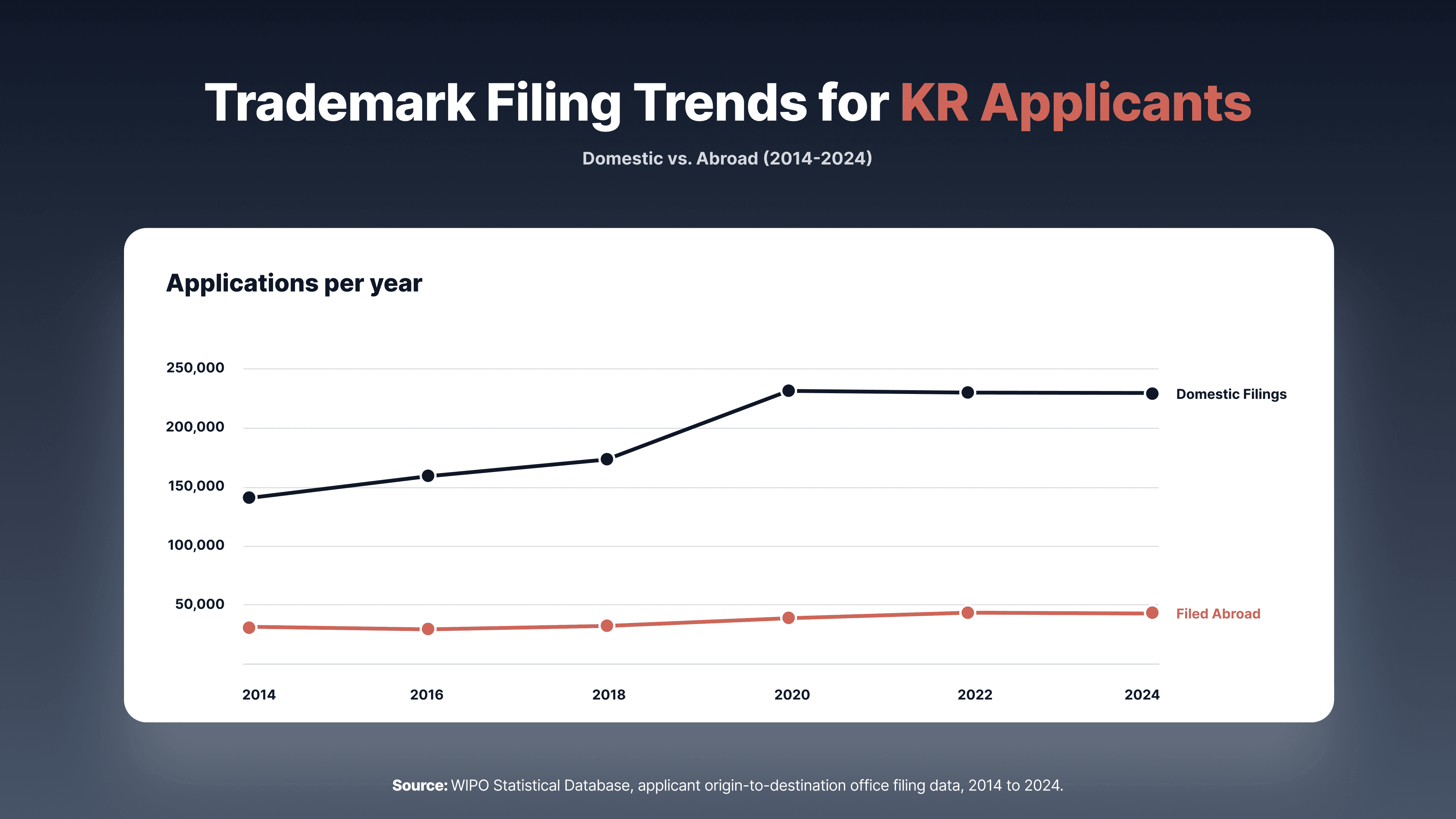
South Korea is one of the most domestically oriented markets, and that hasn't changed in any meaningful way across the entire decade:
Source: WIPO Statistical Database, applicant origin-to-destination office filing data, 2014 to 2024.
Domestic filing volume grew by roughly 65% over the decade, from 138,046 to 227,264 applications, while outbound filing grew by a smaller but still substantial 50%, from 27,398 to 41,124. Because both sides expanded, domestic share moved only modestly, from 83.4% to 84.7%, staying within a fairly tight band throughout. This is a market where total trademark activity has grown substantially across the board, rather than one where applicants have redirected filing from one destination to another,
Where South Korean applicants actually file abroad
Looking at 2024, South Korean outbound filings are led by two major economies before spreading into a broader Asian footprint:
Rank | Destination | South Korean-Origin Applications (2024) |
|---|---|---|
1 | United States | 5,977 |
2 | Japan | 4,545 |
3 | Vietnam | 2,221 |
4 | European Union (EUIPO) | 2,077 |
5 | Indonesia | 1,480 |
6 | Thailand | 1,453 |
7 | Malaysia | 1,264 |
8 | Singapore | 1,247 |
9 | Russia | 1,207 |
10 | United Kingdom | 1,124 |
The US and Japan together account for roughly a quarter of all South Korean outbound filings. Beyond that pair, the list leans heavily toward Southeast Asia, Vietnam, Indonesia, Thailand, Malaysia, and Singapore together outweigh the EU and UK combined, a pattern consistent with the depth of Korean manufacturing and business investment across the region.
Who files into South Korea from abroad
South Korea draws a modest amount of foreign filing activity relative to its own domestic volume. Of the 254,889 total applications filed with KIPO in 2024, 27,625 (10.8%) came from applicants based outside South Korea. The largest foreign filer nationalities were:
Rank | Origin | Applications Filed in South Korea (2024) |
|---|---|---|
1 | China | 8,899 |
2 | United States | 5,875 |
3 | Japan | 2,712 |
4 | Germany | 1,173 |
5 | France | 953 |
6 | United Kingdom | 908 |
7 | Switzerland | 885 |
8 | Singapore | 854 |
9 | Italy | 714 |
10 | Australia | 408 |
China leads foreign filing into South Korea, followed closely by the United States, with Japan a clear third. Together the top three account for well over half of all foreign filing activity, a mix that reflects South Korea's role as a significant regional and global manufacturing hub.
How that outbound volume is actually being filed
A modest but growing pool of outbound filing is only half the picture; the other half is how it's getting filed. Our earlier analysis of Madrid System adoption rates found that the share of total South Korean filing activity arriving via Madrid declined modestly over the same period, from 6.3% in 2014 to 4.8% in 2024. Direct filing has remained the overwhelming default throughout, and its lead has grown slightly rather than narrowed.
What this means in practice
South Korea is a market defined by sustained growth across the board rather than a shift between domestic and international filing, with outbound activity spreading heavily into Southeast Asia alongside the US and Japan, and foreign filing into the domestic office led by China, the US, and Japan in roughly that order. For firms handling outbound work for South Korean clients, a regional Asia strategy matters as much as the US and Japan relationships, and direct filing remains the clear, strengthening default. Trama's WIPO cost and risk calculator can help size up the Madrid versus direct filing decision for any specific South Korea-outbound combination.
For how South Korea compares to other major filing nationalities, and the aggregate trend across all of them, see the full WIPO trademark filing analysis.