Where German filing activity actually lands
Using the WIPO Statistical Database's origin-to-destination filing matrix for 2014 to 2024, this analysis looks at:
How German-origin applicants split their filing between home and abroad
How that split has shifted over the decade
Where their outbound filings actually go
Who files into Germany from abroad
It's part of a wider look at this same question across a dozen major filing nationalities, covered in full here, if you'd like the broader comparison alongside the German-specific detail below.
In 2024, German-origin applicants filed 143,020 trademark applications worldwide, and 72,718 of them were filed abroad, a substantial standing volume of outbound work. The remaining 70,302 (49.2%) were filed only with the German Patent and Trade Mark Office; the outbound share came in at 50.8%.
Put another way: for roughly every domestic application a German applicant files, about one is also filed abroad, a ratio of 1.03 international filings for every domestic one, close to an even split.
Has outbound volume grown, shrunk, or held steady?
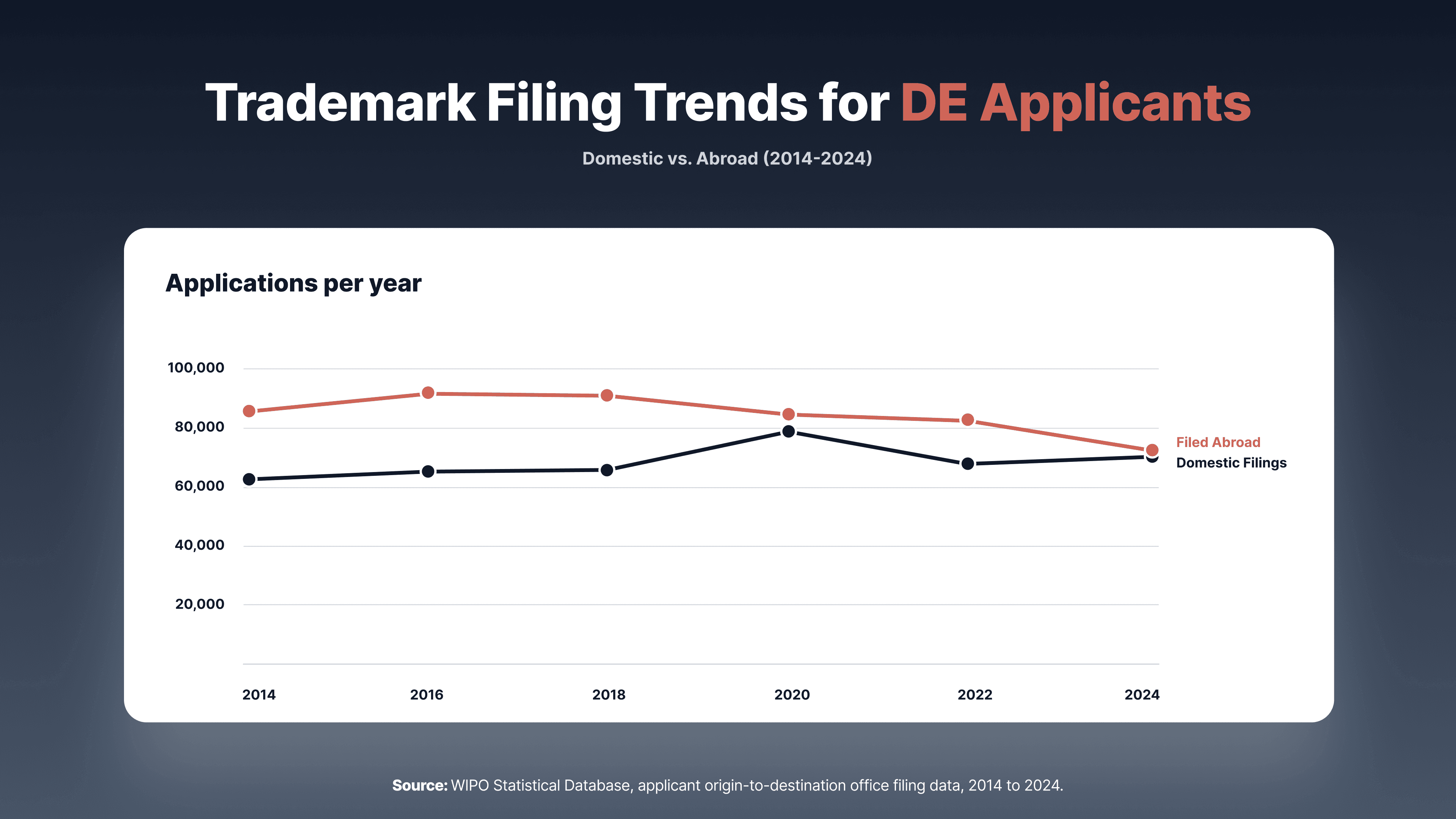
Germany's numbers move gradually rather than in sharp turns, but the direction is consistent.
Source: WIPO Statistical Database, applicant origin-to-destination office filing data, 2014 to 2024.
In 2014, German applicants filed considerably more abroad than at home, 1.36 applications filed abroad for every domestic one. Over the following decade, domestic filing grew modestly while outbound volume actually declined in absolute terms, from 85,888 in 2014 down to 72,718 in 2024, its lowest point in the dataset. By 2024, the two sides had nearly converged, sitting close to a 1:1 ratio for the first time in the period covered.
Where German applicants actually file abroad
Looking at 2024, German outbound filings are dominated by one destination well ahead of everything else:
Rank | Destination | German-Origin Applications (2024) |
|---|---|---|
1 | European Union (EUIPO) | 22,018 |
2 | Switzerland | 4,761 |
3 | United States | 4,308 |
4 | United Kingdom | 4,167 |
5 | China | 1,949 |
6 | Canada | 1,734 |
7 | Norway | 1,519 |
8 | Japan | 1,512 |
9 | India | 1,505 |
10 | Türkiye | 1,398 |
The EU trademark office alone accounts for roughly 30% of all German outbound filings, more than the next nine destinations combined, a reflection of how deeply German businesses rely on the single EU-wide registration to cover their largest export market in one filing. Switzerland, the US, and the UK follow at a fraction of that volume, and the rest of the top ten is spread thinly across a mix of major economies with no single one standing out.
Who files into Germany from abroad
Germany draws comparatively little foreign filing activity relative to its own domestic volume. Of the 80,241 total applications filed with the German office in 2024, only 9,939 (12.4%) came from applicants based outside Germany. The largest foreign filer nationalities were:
Rank | Origin | Applications Filed in Germany (2024) |
|---|---|---|
1 | China | 4,050 |
2 | United States | 871 |
3 | Switzerland | 741 |
4 | United Kingdom | 634 |
5 | Austria | 405 |
6 | Hong Kong | 317 |
7 | France | 285 |
8 | Türkiye | 253 |
9 | Netherlands | 182 |
10 | Belgium | 167 |
China is, as in most major markets in this dataset, the largest source of foreign filing into Germany, more than four times the next largest source, the United States. Still, the 12.4% foreign share understates how much foreign interest actually touches the German market: most foreign businesses seeking protection in Germany do so through the EU trademark, filed with EUIPO rather than the German national office, since a single EU-wide registration already covers Germany alongside every other member state.
The figures above capture only direct national filings into Germany, the visible fraction of a much larger flow of foreign filing activity that reaches the German market by a different route entirely.
How that outbound volume is actually being filed
A large pool of outbound filing is only half the picture; the other half is how it's getting filed. Our earlier analysis of Madrid System adoption rates found that the share of total German filing activity arriving via Madrid actually fell over the same period, from 6.0% in 2014 to 3.8% in 2024. This shows that direct filing is becoming even more dominant over time, tracking the same broader move toward domestic-first filing seen in the numbers above.
What this means in practice
Germany is a market quietly converging: outbound and domestic filing sitting almost evenly by 2024, foreign filing into Germany a comparatively small share of total activity, and Madrid's role shrinking rather than growing. For firms handling outbound work for German clients, the EU trademark office is where the large majority of that work is headed, and direct filing is the clear and strengthening default rather than an alternative to Madrid. Trama's WIPO cost and risk calculator can help size up the Madrid versus direct filing decision for any specific Germany-outbound combination.
For how Germany compares to other major filing nationalities, and the aggregate trend across all of them, see the full WIPO trademark filing analysis.