Where Canadian filing activity actually lands
Using the WIPO Statistical Database's origin-to-destination filing matrix for 2014 to 2024, this analysis looks at:
How Canadian-origin applicants split their filing between home and abroad
How that balance has shifted over the decade
Where their outbound filings actually go
Who files into Canada from abroad
It's part of a wider look at this same question across a dozen major filing nationalities, covered in full here, if you'd like the broader comparison alongside the Canadian-specific detail below.
In 2024, Canadian-origin applicants filed 40,972 trademark applications worldwide. Of those, 21,828 (53.3%) were filed only with the Canadian Intellectual Property Office (CIPO), and 19,144 (46.7%) were filed abroad.
Put another way: for roughly every ten applications a Canadian applicant files at home, close to nine are also filed abroad, a ratio of 0.88 international filings for every domestic one, close to an even split.
Has outbound volume grown, shrunk, or held steady?
Canada's filing behavior has moved consistently toward more outbound activity over the decade, a clearer and steadier shift than a lot of major filing nationalities show.
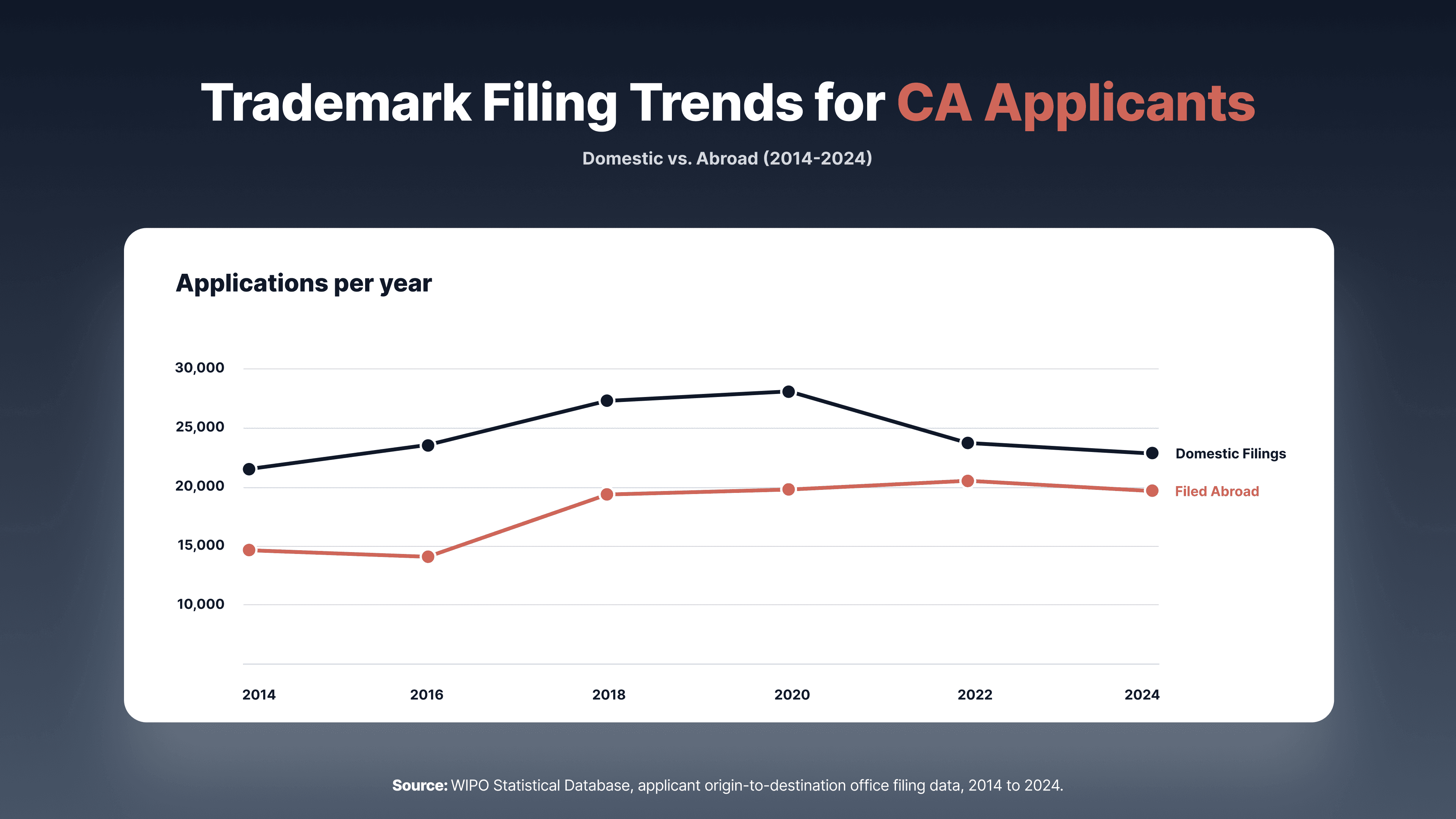
Source: WIPO Statistical Database, applicant origin-to-destination office filing data, 2014 to 2024.
Domestic share fell from 59.3% in 2014 to 53.3% in 2024, and the shift shows up clearly in the ratio, which climbed from 0.69 to 0.88 applications filed abroad for every domestic one. Domestic filing volume itself has actually declined since its 2019 peak of 28,588, while outbound filing has grown far more steadily, from 14,669 applications a year in 2014 to over 19,000 in most recent years.
Where Canadian applicants actually file abroad
Looking at 2024, Canadian outbound filings are dominated by one neighbor well ahead of everywhere else:
Rank | Destination | Canadian-Origin Applications (2024) |
|---|---|---|
1 | United States | 8,664 |
2 | European Union (EUIPO) | 1,296 |
3 | United Kingdom | 1,153 |
4 | Mexico | 660 |
5 | Australia | 618 |
6 | India | 447 |
7 | Japan | 394 |
8 | South Korea | 375 |
9 | Brazil | 296 |
10 | United Arab Emirates | 259 |
The United States alone accounts for roughly 45% of all Canadian outbound filings, more than six times the next largest destination, the EU trademark office. That concentration reflects the depth of cross-border commercial integration between the two countries; beyond the US, the rest of the top ten spreads thinly across a broad mix of major economies with no other single destination coming close.
Who files into Canada from abroad
Canada draws an exceptionally large amount of foreign filing activity relative to its own domestic volume. Of the 67,156 total applications filed with CIPO in 2024, 45,328 (67.5%) came from applicants based outside Canada, more than two-thirds of all Canadian filing activity. The largest foreign filer nationalities were:
Rank | Origin | Applications Filed in Canada (2024) |
|---|---|---|
1 | United States | 17,870 |
2 | China | 9,859 |
3 | United Kingdom | 1,923 |
4 | Germany | 1,734 |
5 | France | 1,614 |
6 | Japan | 1,215 |
7 | Switzerland | 1,191 |
8 | South Korea | 928 |
9 | Italy | 924 |
10 | Australia | 895 |
The United States is, by a clear margin, the largest source of foreign filing into Canada, nearly double the next largest source, China. Together the two account for well over half of all foreign filing activity in Canada, a market where geographic proximity to the US and Canada's role as a significant filing destination for Chinese applicants both show up clearly in the data.
What this means in practice
Canada is a market moving steadily toward more outbound filing, heavily concentrated on the United States as its single dominant destination, and drawing an unusually large share of foreign filing activity, split fairly evenly between US and Chinese applicants.
For firms handling outbound work for Canadian clients, the US relationship covers by far the largest share of that work, and direct filing remains the clear majority route even as Madrid has found a real foothold since Canada joined. Trama's WIPO cost and risk calculator can help size up the Madrid versus direct filing decision for any specific Canada-outbound combination.
For how Canada compares to other major filing nationalities, and the aggregate trend across all of them, see the full WIPO trademark filing analysis.