What is the prevalence of brand infringement among small and medium sized enterprises?
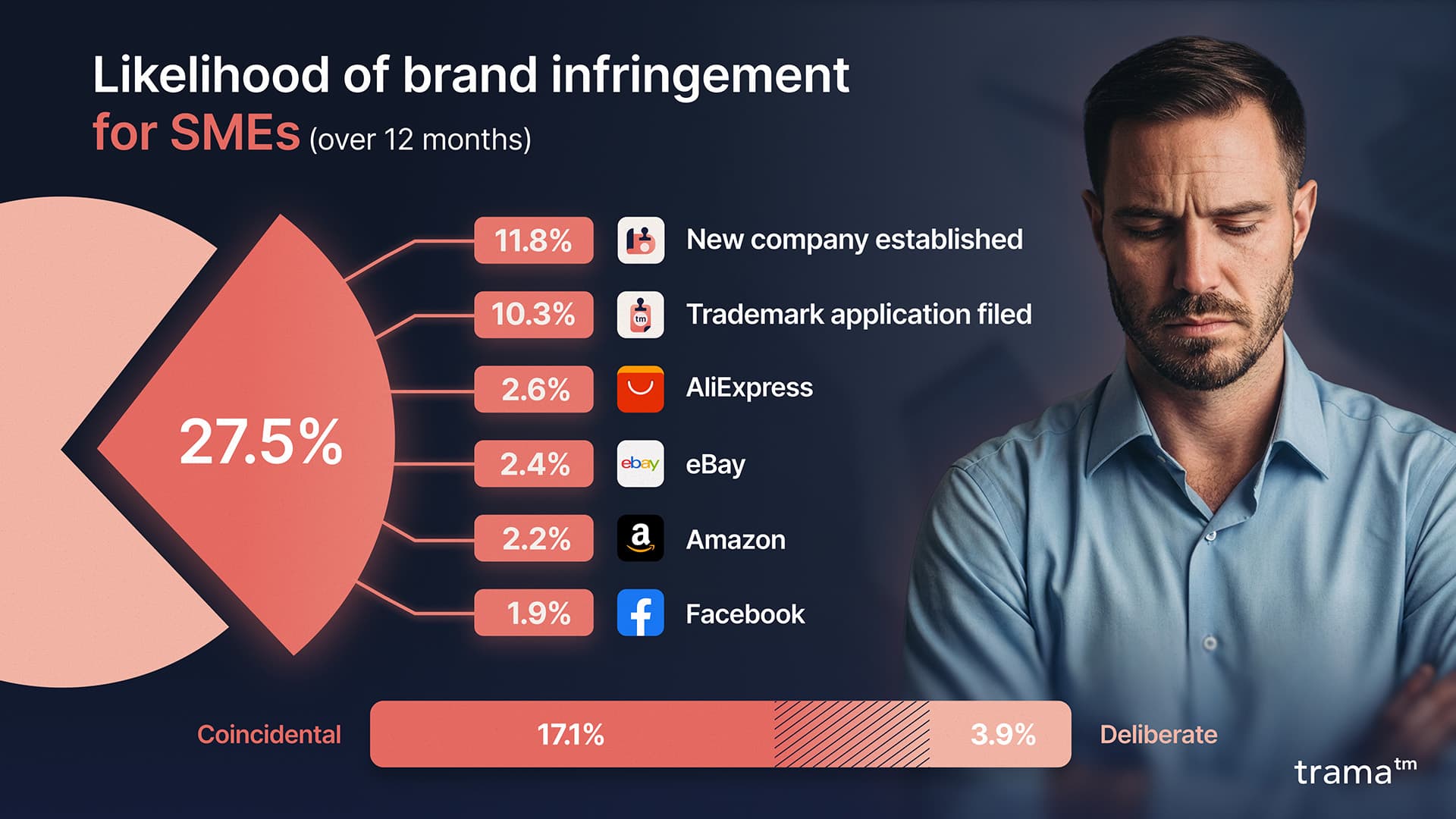
On average, 27.5% of small and medium sized enterprises in our sample have experienced brand infringement in some form over 12 months. This means that 1 in 4 companies can be expected to encounter brand infringement each year.
Industry-specific differences should however be noted. The highest prevalence of brand infringement was encountered by e-commerce companies which in addition to the more general threats (i.e. new company being established; new trademark application being filed) also experienced both coincidental and deliberate brand infringement on various e-commerce (e.g. Amazon, AliExpress) and social media platforms (e.g. TikTok, Instagram).
The second aspect that affects the prevalence of brand infringement is obviously the size of the organisation. While coincidental brand infringement affects smaller businesses regardless of their revenue, deliberate brand infringement is increasingly more prevalent for companies that exceed $500K in annual revenue.
What are the most common types of brand infringement experienced by small and medium sized enterprises?
The most prevalent types of brand infringement experienced by small and medium sized enterprises in our sample included:
1) New company being established (showing significant similarity to the brand name & overlap in business area): 11.8%
2) New trademark applications filed (showing significant similarity to the brand name & overlap in goods and services provided as well as country of operation): 10.3%
In terms of prevalence, the two more general types of infringement outlined above were followed by brand infringements on e-commerce, social media and other online platforms. In these cases, the infringements took a variety of forms, including fake profiles and listings.
3) AliExpress: 2.6%
4) eBay: 2.4%
5) Amazon: 2.2%
6) Facebook: 1.9%
7) Temu: 1.8%
8) Youtube: 1.8%
9) Instagram: 1.7%
10) TikTok: 1.4%
11) Shein: 1.3%
12) Google Play: 0.9%
13) App Store: 0.8%
14) Web domain: 0.7%
15) Etsy: 0.4%
While brand infringement may be limited to a single area or platform, in reality, the uncovered brand infringements often affected the SMEs in our sample through multiple channels. An example can be made of the pair of social media platforms Facebook and Instagram. The vast majority of brand infringements experienced on Instagram was also observed on Facebook. A similar observation was made when it comes to brand infringement on Google Play (0.9% of sampled companies experienced infringement) and App Store (0.8% of sampled companies experienced infringement), with 0.7% of the sampled companies experiencing brand infringement simultaneously on both of these platforms. A breakdown of these cross-platform infringements within the studied sample is provided below.
Trademark registry & Business registry: 4.2%
eBay & AliExpress: 1.7%
Facebook & Instagram: 1.5%
AliExpress & Shein & Temu: 1.2%
Google Play & App Store: 0.7%
Trademark registry & Amazon: 0.6%
Trademark registry & Business registry & Web domain: 0.5%
Amazon + eBay + AliExpress: 0.3%
eBay + Etsy: 0.3%
Facebook & Instagram & TikTok & Youtube: 0.2%
Deliberate versus coincidental brand infringement: What is the difference?
While 27.5% of the smaller companies included in our sample experienced some form of brand infringement over the period of 12 months, only 3.9% have experienced deliberate brand infringement as characterised by the counter-party purposefully copying or imitating the original brand. Conversely, 17.1% of companies experienced something we can label as coincidental brand infringement. In these instances, no clear link nor clear signs of deliberate conduct were uncovered. The counter-party seemed to have adopted a confusingly similar brand name without any prior knowledge of the original brand. For the remaining 6.5% of companies that experienced brand infringement, it was rather unclear whether they represented coincidental or deliberate type of brand infringement.
What actions can small and medium sized enterprises take against brand infringement?
Effective response to brand infringement takes into consideration the type of the infringement as well as the contextual factors. Starting with the coincidental type of brand infringement as this is the more common type of infringement experienced by smaller companies, the effective response is dependent on the early discovery. A simple notification or a friendly warning letter may in fact be sufficient to make the counter-party aware about the clashing rights and encourage them to engage in voluntary re-branding. This solution is however more likely at the start of the counter-party’s entrepreneurial journey, while they are not too heavily invested in their brand.
Furthermore, a wide variety of legal means can be used to protect the original brand’s rights, including platform takedowns, cease and desist letters, trademark opposition proceedings, and ultimately litigation. The effectiveness and in some cases even applicability of these tools however declines over time as from a legal standpoint, sustained co-existence of two similar brands over a longer period of time is reasonable evidence that no damaging impacts are experienced.
On the other hand, deliberate brand infringement requires a thorough analysis of the specific nature of the case and strategic response. While simple cases of deliberate infringement can be effectively silenced with the use of online platform takedown mechanisms, a more complex approach is often required to discourage better organised brand infringement attempts.
In the cases of both coincidental and deliberate types of brand infringement, early recognition of the threat is absolutely crucial in devising effective response.
Optimal brand protection strategy for small and medium sized enterprises
Run a trademark clearance search for your brand at the very start: This step is often overlooked but absolutely essential as it ensures that the new business venture is not infringing on other companies’ intellectual property rights. The inclusion of this search can be also used to shape the brand name so that it can be effectively protected.
Secure your trademark rights: National trademark registration is a very good start to safeguard the brand’s reputation as it provides the essential step in simplifying the process of brand protection. Trademark registration certificate enables seamless enforcement via online platform takedown mechanisms, opposition proceedings and greatly simplifies the process of more challenging situations which require litigation.
Continuous brand monitoring: Uncovering the potential threats as soon as they emerge is absolutely crucial when it comes to effective brand protection. Continuous brand monitoring is therefore strongly recommended.
Extend trademark protection and brand monitoring as you scale: Each business is unique and has unique brand protection needs. While a national trademark registration and a monthly monitoring of trademark and business registers is perfectly sufficient to ensure adequate protection for one brand, another brand may require weekly monitoring across all online platforms and a growing portfolio of international trademark registrations. Regardless of your needs, team Trama is here to guide you.
Why should smaller companies consider brand monitoring services?
Threat prevalence: One in four (27.5%) of smaller businesses have experienced brand infringement over a 12 month period.
Direct and indirect negative impacts: Lost revenue, damaged reputation of the brand, loss of customer loyalty are only some of the measurable impacts caused by both deliberate and coincidental brand infringement.
Early recognition is crucial: For both coincidental and deliberate forms of brand infringement, uncovering the threats early greatly simplifies the solution and prevents the threat from intensifying.
Effective brand monitoring & protection is more affordable and simple than you may think: Brand protection with Trama
Quicklinks
Brand monitoring by Trama and safeguard your brand
Report brand infringement and let team Trama guide you through your options
Schedule a consultation to start your journey with Trama