What is the Madrid System?
The Madrid System is an international trademark registration mechanism that allows brand owners to file a single application to seek protection in over 130 member countries. This system is governed by the Madrid Agreement (1891) and the Madrid Protocol (1989).
Rather than filing separate trademark applications in each country (which can be time-consuming, expensive, and administratively complex), the Madrid System combines it into one central application, filed through your home IP office and processed by WIPO.
Filing a trademark through the Madrid System
1. Secure a basic mark
Before using the Madrid System, you must have already filed or registered your trademark in your home country (one that is a member of the Madrid Union). This initial application or registration is called your basic mark.
2. File an international application
Once your basic mark is in place, you submit an international application through the same national IP office (known as the Office of Origin). This application will list all the countries where you wish to register your trademark (known as designated contracting parties). The Office of Origin checks that your application aligns with your basic mark and then forwards it to WIPO.
3. Formal examination by WIPO
WIPO conducts a formal examination to ensure the application meets administrative requirements (e.g., classifications, fees, etc.). If everything checks out, WIPO records the mark in the International Register and publishes it in the WIPO Gazette.
4. Substantive examination by each designated country
Each country’s national IP office conducts its own examination of the trademark based on local laws. They may approve, reject, or request clarifications. This part of the process can take up to 18 months, or longer in some jurisdictions.
If a country raises an objection, you'll need to respond locally, often with the help of a trademark attorney in that country. Provided there will be no objections or oppositions, your mark will be registered and valid for the next 10 years.
What to know before you file: 5 main limitations of WIPO
Although the Madrid System allows brand owners to conveniently apply for a trademark in multiple countries, there are disadvantages you should be aware of before choosing this option:
You must have a pending/registered trademark in one of the member countries of WIPO. This is called a basic filing or a basic mark. If your basic mark fails to be registered, the rest of the WIPO applications will be cancelled as well.
Even if your basic mark passes and gets registered, if it's cancelled or limited within the first five years after registration, it will result in the cancellation or limitation of all the designations of the international registration.
The process is quite lengthy. National offices have up to 18 months (or more) to issue refusals. In contrast, national filings in some countries usually pass quicker.
If you wish to change the ownership of your international registration, the assignee has to be a person authorised to file an international application.
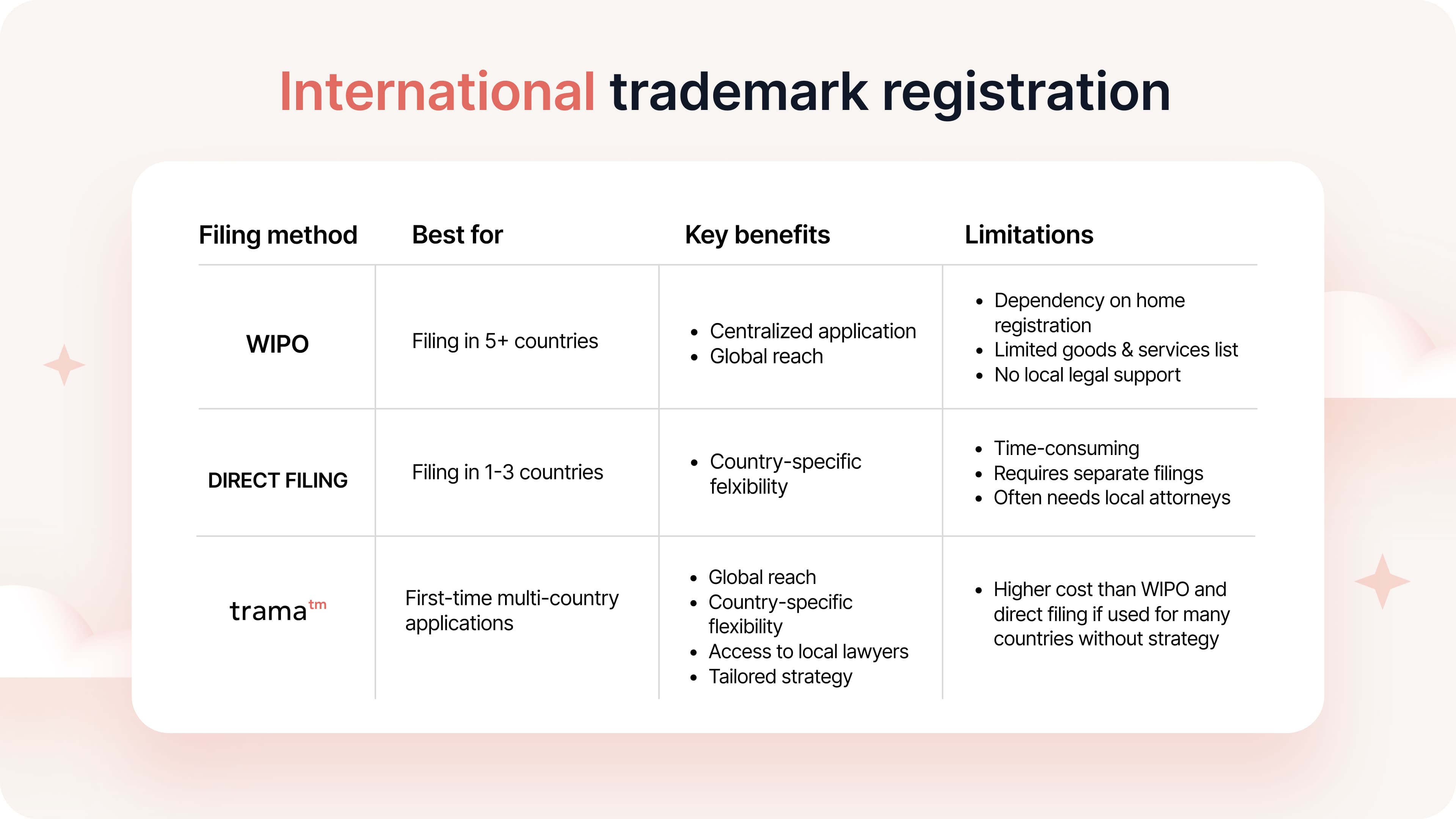
The registration can cost more than going through each national IP office individually. This depends on the number and selection of countries, but generally, WIPO is more cost-effective from five countries up.
WIPO vs. Direct Filing vs. Trademark Services
While WIPO offers a centralized route, it’s not always the best fit for businesses targeting just a few countries or lacking legal support. In many cases, filing directly with national trademark offices can be simpler, more cost-effective, and legally safer.
For companies looking for more tailored trademark protection, especially when dealing with niche product descriptions or navigating legal challenges in individual countries, Trama provides tools and legal support aimed at simplifying the process while maintaining global reach.
With Trama, you get:
A free legal check of your trademark in any country
Direct filings with national offices in over 100 countries
In-house legal support from trusted lawyers
A clear, online dashboard to track everything in one place
Here’s a practical breakdown of these three options for effective international trademark registration: